
Plac1 Ablation Disrupts Signaling Pathways Essential for Prenatal Development and Induces a Preeclampsia-Associated Transcriptomic Signature
Suzanne Jackman¹*, Xiaoyuan Kong¹*, Yulan Piao², Alexei Sharov², Elin Lehrmann², Andrew Varshine², Ramaiah Nagaraja², David Schlessinger² and Michael E. Fant¹‡
¹Department of Pediatrics, University of South Florida, Morsani College of Medicine, Tampa, FL ²Laboratory of Genetics and Genomics, National Institute on Aging, National Institutes of Health, Baltimore, Maryland
*S. Jackman and X. Kong contributed equally to this work. ‡ Correspondence – mfant@usf.edu
Abstract
Plac1 is an X-linked gene essential for placental and embryonic development. A knockout (KO) mouse model was used to identify Plac1-regulated gene expression at E16.5 and E18.5 using gene expression microarray. Genes exhibiting at least 1.5-fold change in expression and FDR < .05 were considered significant. At E16.5, 717 genes were downregulated and 798 were upregulated in male KO placentas versus wild type (WT), whereas at E18.5, 1122 genes were downregulated and 1149 were upregulated. GO, KEGG, and IPA analyses revealed downregulated genes were enriched for Rho GTPase-mediated and actin-cytoskeleton based processes that transmit extracellular cues through canonical signaling pathways, including Integrin, GPCR, Wnt, Notch, VEGF, BMP and TGF-beta, documented to impact trophoblast development, vasculogenesis, vascular tone, branching morphogenesis, and immunomodulation. Furthermore, a preeclampsia-associated transcriptomic signature was induced that strengthened over time. By contrast, upregulated genes reflected immune activation and adaptations to oxidative stress resulting from impaired placental function. These findings indicate that Plac1 supports signaling required to maintain placental structure and regulatory function. Its absence disrupts essential regulatory processes and triggers cellular stress and immune activation, contributing to fetal growth restriction, increased risk for embryopathy and preeclampsia, consistent with the Developmental Origins of Health and Disease (DOHaD) framework.
Key Words: Plac1; placental development; Rho GTPase signaling; fetal growth restriction (FGR); birth defects; cardiovascular disease; preeclampsia; brain development; Developmental Origins of Health and Disease (DOHaD)
1. Introduction
Plac1 is an X-linked gene that maps to a chromosomal locus previously shown to be important for placental and embryonic development [1]. Its expression is particularly high in the placenta, hence its name Placenta-specific 1, as the placenta was initially thought to be the only locus of its expression [1][2]. Subsequent studies, however, have demonstrated that it is also expressed throughout the developing embryo, albeit at 1-10% of placental expression levels, suggesting a broader role in embryonic development. Its expression in adult animals, however, diminishes to essentially undetectable levels [3]. The human PLAC1 gene encodes a putative protein of 212 amino acids, whereas the mouse ortholog has 173 amino acids with 65% homology [1]. The protein is predicted to exist as a membrane-associated or extracellular peptide (PSORT: psort.ims.u-tokyo.ac.jp ). Consistent with targeting to a membranous compartment, a predicted transmembrane ™ domain lies at aa 23 – 40 from the N-terminus. Within the placenta, PLAC1 is expressed exclusively in the trophoblast, where its expression is tightly linked to differentiation of the syncytiotrophoblast [1][2][4]. Immunohistochemical analysis of cytotrophoblasts has demonstrated distribution throughout the cytosolic region as well as near the plasma membrane. By contrast, its localization in the differentiated syncytiotrophoblast is highly restricted to the apical cytosolic region in proximity to the maternal-facing microvillous membrane surface [5].
An essential role for Plac1 in placental and embryonic development has been demonstrated in a mutant mouse model [6]. Placentas in Plac1-null mice exhibit placentomegaly with an enlarged and disorganized junctional zone (JZ), characterized by spongiotrophoblast (SpT) hyperplasia and associated with mild fetal growth restriction. Consistent with preferential paternal X chromosome inactivation in murine extraembryonic tissue [7][8], genetic analyses revealed that placentas derived from maternal (X^m^X) heterozygotes (Hets) were phenotypically similar (but not identical) to knockout (KO) placentas whereas paternal (XX^p^-) Hets were phenotypically identical to wild type (WT). Further analysis suggested that the paternal Plac1 allele is not completely inactivated, with approximately 10-15% residual activity remaining, providing some degree of functional activity in the X^m^X Het not observed in the KO.
A functional role for Plac1 was also shown to extend to the embryo proper. Surviving Plac1 mutants (Plac1-null males and X^m^X females) developed postnatal hydrocephalus with increased frequency, 22% and 11% respectively, suggesting Plac1 plays an important role in fetal brain development. The changes in the placental phenotype were later supported by Muto, et al, using a mutant mouse model derived using a different targeting vector and bred against a different mouse strain [9]. By employing Lentivirus-mediated Plac1 expression, they were also able to show that Plac1 rescue failed to reverse the overgrowth of the spongiotrophoblast layer but did ameliorate changes in the labyrinth, pointing to temporal aspect(s) of Plac1 function.
PLAC1 expression has also been shown to be reactivated in a wide range of human cancers and cell lines in which it influences cell proliferation and migration in vitro . Its in vivo expression in tumors has been linked to increased metastasis risk and decreased survival [reviewed in 10].
We applied our mutant mouse model to the identification of genes and signaling pathways regulated by Plac1 that drive placental development and embryogenesis. Given the high degree of conservation of Plac1 between mouse and human, and its highly restricted, trophoblast-specific expression, Plac1 is likely to occupy an upstream position within regulatory hierarchies that coordinate placental growth, differentiation, and maternal–fetal exchange. Accordingly, the objective of this study was not to resolve the full regulatory cascade downstream of Plac1, but rather to establish a framework describing the physiological and signaling landscapes perturbed by its loss. By integrating gene-level expression changes with pathway and systems-level analyses, we aimed to identify the core biological processes dependent on Plac1 during late gestation and to generate a cohesive, hypothesis-generating model of its role in placental development and pregnancy maintenance. Accordingly, this study combines gene-centric analysis of highly dysregulated transcripts and reciprocally regulated genes with complementary GO, KEGG, and IPA analyses. This integrative strategy was designed to facilitate interpretation by multidisciplinary groups of investigators and to establish a biologically coherent framework upon which future mechanistic studies can build.
2. Results
2.1 Developmental dynamics of placental growth in Plac1 mutants
We focused this analysis on the period of pregnancy when the growth trajectory of Plac1-null placentas exhibit maximal divergence from WT placentas. Placentas associated with Plac1-null embryos and maternal Hets (X^m^X) exhibit placentomegaly and a disorganized junctional zone (JZ) [6]. Placental weights of X^m^X Hets diverge from KO littermates between E16.5 and E18.5, likely because the paternal allele escapes complete inactivation. As we previously reported [6] and summarize in Figure 1, X^m^X Het placental weight peaks at E16.5 and decreases slightly thereafter. By contrast, the weight of Plac1-null placentas continues to accelerate until E17.5 and then plateaus. These observations guided our transcriptomic analysis of the developmental span bordered by E16.5 and E18.5.
![Figure 1: Growth trajectories of placentas from Plac-1 mutants compared to WT placentas. Placental weights were determined throughout gestation representing WT, X^m^X, and KO mice and presented in graphical form summarizing previously published data [6]. Each point represents the mean of age-specific samples for each genotype (n = 1-10 per data point). WT and KO data include both male and female placentas.](https://qzydlaimdnpogmrslkea.supabase.co/storage/v1/object/public/manuscripts/figures/upload-1777992173558/fig-01-p5.png)
2.2 Gene Expression Microarray Analysis
The Agilent 4x44k gene chip, representing the entire mouse genome, was used to identify Plac1-dependent gene expression at E16.5 and E18.5. KO male placentas were compared to WT male placentas in duplicate samples. At E16.5, 717 known or putative genes were downregulated and 798 genes were upregulated at least 1.5-fold (FDR < .05) in KO placentas compared to WT. Similarly, at E18.5, 1122 genes were downregulated and 1149 genes were upregulated. (See supplemental materials, Tables S1-S7, for processed data and complete gene lists).
Principal Component Analysis (PCA) (Supplemental Table, S3) revealed that the first three components explained 79.1% of the variance (PC1: 41.7%, PC2: 25.33%, PC3:12.07%). Visual inspection of PC1 and PC2 (Figure 2) indicates that PC1 primarily separated samples by gestational age (E16.5 versus E18.5, whereas PC2 distinguished genotypes (WT from KO). Female samples are included to provide reassurance regarding the overall coherence and quality of the expression data derived from the male samples and are shown for qualitative visualization only. No statistical or comparative conclusions were drawn due to the lack of biological replication. The WT female sample appeared modestly separated from the KO female, suggesting a potential female specific expression pattern (possibly contributing to PC3). Because Plac-1 is X-linked, subtle sex dependent effects are not unexpected. However, this observation should be interpreted cautiously given the lack of female replicates.
![Figure 2: PCA of normalized expression data: E16.5 and E18.5 placentas (WT and KO). PC1 and PC2 explain [41.70%] and [25.33%] of the variance, respectively. PC1 separates E16.5 vs E18.5, PC2 separates WT vs KO. Points are labeled by age, sex, genotype, and replicate. Color = genotype (WT = blue, KO = red); Shape = age (E16.5 = circles, E18.5 = triangles); Black outline = female. Note there is only one female replicate per genotype and are shown for descriptive purposes only. No statistical or comparative conclusions were drawn due to the lack of biological replication.](https://qzydlaimdnpogmrslkea.supabase.co/storage/v1/object/public/manuscripts/figures/upload-1777992173558/fig-02-p6.png)
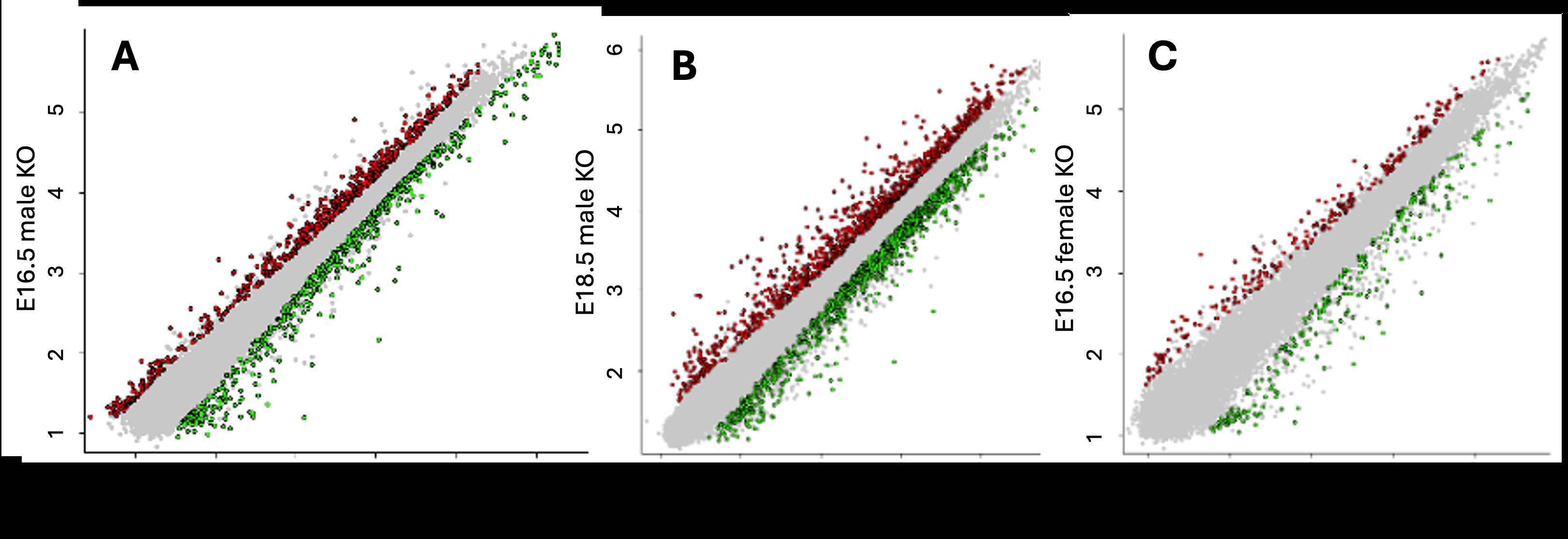
KO versus WT scatter plots are shown for each age/sex group (Figure 3). Most genes lie near the diagonal reference line, indicating broadly similar expression between KO and WT. Colored points denote differentially expressed genes (DEGs) meeting our threshold (≥1.5-fold change, FDR < 0.05). Red indicates upregulated genes in the Plac1 KO and green indicates downregulated KO genes. Grey points indicate genes not significantly dysregulated. Axes show log₁₀ expression values. Panel A and panel B display replicate means for males, whereas panel C shows values from one female per genotype.
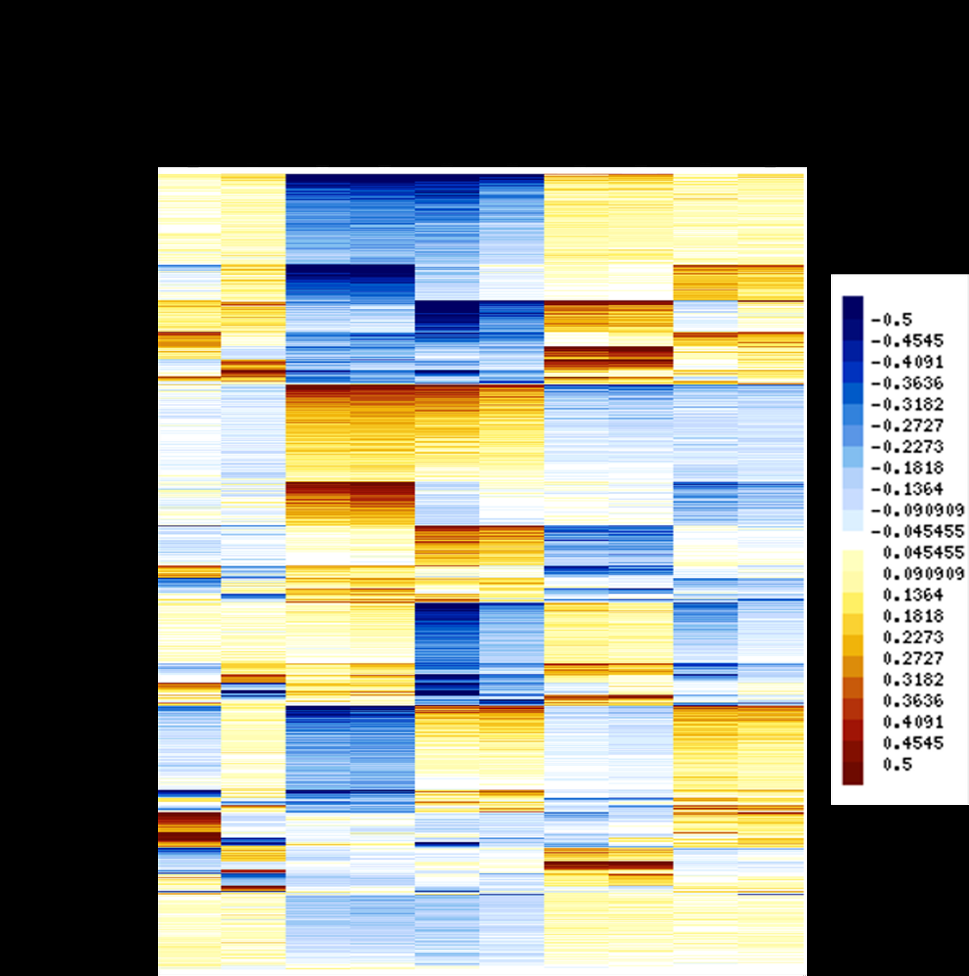
The heatmap of DEGs meeting our cutoff criteria of ≥1.5 fold change and FDR < 0.05 is shown in Figure 4. Differential expression was assessed using linear mixed-effects model with subjects treated as a random effect. Expression values are visualized, with genes (rows) ordered by hierarchical clustering. Although hierarchical clustering was applied only to genes and not to samples, several gene clusters exhibit expression patterns that appear to align with trends observed in the PCA. Specifically, a subset of genes revealed slightly divergent expression in WT versus KO females. However, again because of the lack of female replicates, a possible sex-associated trend should be interpreted cautiously.
2.3 RT-qPCR Validation of Differentially Expressed Genes
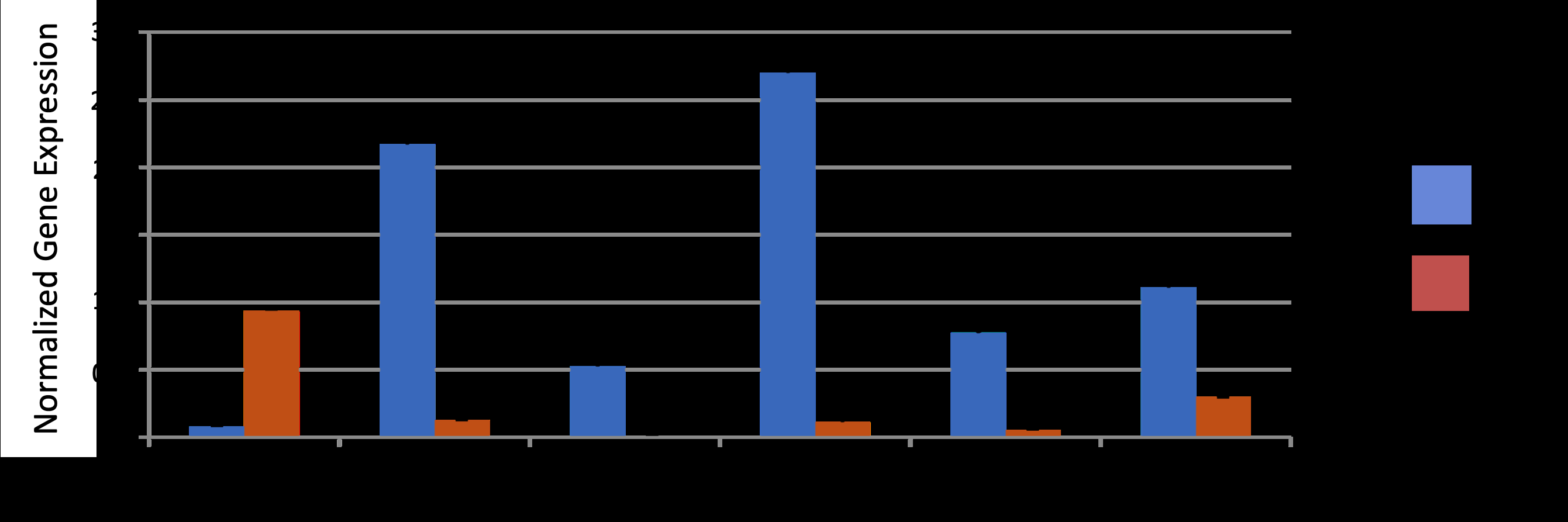
A panel of genes were selected to validate the original microarray results when it was first carried out. Five downregulated genes (Cnn1, Elavl4, Nppb, Slc6a15, Zbtb4) and one upregulated gene (Cer1) were assessed in placentas at E18.5 (Figure 5). The results were qualitatively consistent (directional change) with the current (2026) microarray analysis. These data represent the mean of two biological replicates assayed in triplicate per genotype (See Supplemental Data, S8).
Diminishing availability of mutant placentas due to colony attrition limited the number of genes that could be assayed. While these results are supportive of our microarray expression data, we acknowledge the limitations imposed by the small sample size on performing a robust statistical analysis. Surveying a larger sample of genes derived from multiple placentas will be necessary to establish a statistically powered qPCR validation in future studies.
2.4 Gene-Level Curation of Dysregulated Genes
Given the complexity of placental development and its sensitivity to temporal and physiological context, we initially approached the Plac1-regulated transcriptomic changes by manually curating a limited subset of highly dysregulated and developmentally informative genes. Importantly, these uniquely dysregulated subsets represent the unbiased identification of genes likely to play significant roles in the pathophysiological responses to Plac1’s absence. This gene-centric approach provides a time-resolved physiological perspective, highlighting directionality, adaptation, and potential compensatory programs that can otherwise be obscured when transcripts are immediately aggregated into higher-order categories. We then applied GO, KEGG, and IPA analyses to gain a systems-level interpretation, allowing pathway-level structure to be layered onto a biologically grounded narrative derived from the most salient gene-level changes.
DEGs exhibiting the highest fold-change at E16.5 and E18.5 were examined for potential relevance to the Plac1-null phenotype (See Supplemental Tables, S4–S7, for complete gene lists). Their hierarchical order differed at each gestational age, reflecting the placenta’s intrinsic developmental program and its adaptations to deficits resulting from Plac1’s absence. We also identified small subsets of DEGs showing reciprocal directional dysregulation over time (e.g., downregulation at E16.5 followed by upregulation at E18.5) and examined these patterns as possible indicators of evolving pathophysiology. Functional inferences that emerged are intended to suggest plausible interpretations based on known or inferred gene function as well as placental physiology. Definitive interpretation will require experimental validation in the future.
2.4.1 Downregulated Genes: Inferred Functional Deficits
To provide biological context for the most prominent transcriptional changes, we first focused on a small subset of the most strongly downregulated genes at E16.5 and E18.5. Many of these genes are linked to immune–trophoblast interactions, membrane or vesicular processes, endocrine signaling, and transcriptional programs associated with late placental maturation. Discussion of these genes individually offers insight into potential functional consequences of Plac1 loss at the level of specific cellular programs, prior to the broader pathway-based analyses.
At E16.5, KO placentas showed marked decreases in granzymes ( Gzmc, Gzmf, Gzmg; and Gzmd ~13-fold) versus WT (Table 1). Granzymes are produced by uterine natural killer cells (uNKs), not trophoblasts. uNKs promote spiral artery remodeling by facilitating invasive trophoblast differentiation and depth (11–13). Their reduction therefore suggests either fewer uNKs or reduced uNK–trophoblast encounters needed to induce granzyme expression. Pertinent to this, PLAC1 has been shown to interact directly with NK activating proteins (NKG2D, NKp30, NKp44, DNAM-1) and can modulate NK cytotoxicity [14]. If reduced trophoblast invasion occured early in placentation, consistent with PLAC1’s role in trophoblast invasion/migration in culture [15], uNK activation would be limited, impairing spiral artery remodeling and contributing to later placental insufficiency.
| E16.5 | E18.5 | |||
|---|---|---|---|---|
| Downregulated | Fold Change | Upregulated | Fold Change | Downregulated |
| Plac1 | -73.063 | Igfbp1 | +15.174 | Plac1 |
| Tff3 | -22.146 | Khdc1b | +13.586 | Krt6a |
| Gzmg | -21.952 | Minar1 | +9.727 | Elavl4 |
| Angptl3 | -19.512 | Syt15 | +9.467 | Bhlhe22 |
| Gzmf | -17.179 | Farp1 | +9.12 | Ntrk2 |
| Gzmc | -16.634 | Ifi203 | +7.984 | Ceacam18 |
| Vmn1r17 | -16.118 | Tcra | +7.912 | Dio2 |
| Ehd4 | 15.531 | C730014E05Rik | +7.248 | Or51e2 |
| Neurod4 | -14.461 | Gabrq | +6.871 | Isx |
| 9330162B11Rik | +6.634 | Gzmc |
Table 1. Top Up- and Downregulated Genes at E16.5 and E18.5 (P-value and FDR < 0.05)
A second potential explanation is impaired recruitment of uNKs to the maternal–placental interface. Cxcr4 , a GPCR for Cxcl12, mediates uNK homing to decidua, and Cxcr4 deficiency reduces uNK numbers, disrupts placental vasculature, and causes pregnancy loss [16]. Although neither gene is dysregulated in our study, the E16.5–E18.5 window occurs well after early placentation and would not be expected to capture earlier recruitment signatures. Interestingly, Tff3 (second most downregulated) can also bind Cxcr4 and promote epithelial recruitment in retina [17], but there is no evidence it acts as a gestational chemoattractant. Instead, Tff3 protein is expressed across multiple mouse epithelia at E14–E18, contributing to maturation and barrier formation [18]. Thus, its downregulation more likely reflects collapse of secretory epithelial maturation in the placenta, consistent with labyrinth expression reported in Bgee [19] and syncytiotrophoblast/JZ/sTGC expression in STAMP [20].
Evidence of early vascular impairment is further strengthened by disruption of the trophoblast–vascular interface. Angptl3 downregulation suggests impaired nutrient delivery and labyrinthine function [21–23]. Its C-terminal domain binds integrin αvβ3 to promote endothelial adhesion/migration/vessel formation. Reduced expression would therefore limit migration and capillary branching. Angptl3 also inhibits endothelial lipase and LPL, potentially affecting lipid availability and essential fatty-acid delivery to the fetus. In parallel, Ehd4 , an intracellular trafficking protein, participates in a PACSIN2/EHD4/MICALL1 complex controlling VE-cadherin recycling during sprouting angiogenesis [24]. Together, these changes point to the possible loss of regulatory integrity between trophoblasts and the endothelium.
Stress-related compromise was suggested by the profound downregulation of Krt6a , typically induced in stratified epithelia in response to stress [25] and implicated in abnormal placentation (placenta accreta) [26]. Here Krt6a is ~45-fold reduced, consistent with decompensated stress, and is accompanied by reduction of additional keratins, Krt8 and Krt18 , suggesting late-gestation trophoblast instability. Downregulation of Ceacam18 , expressed in decidua, spongiotrophoblasts, sTGCs, and labyrinthine trophoblasts, further suggests membrane disruption. While its placental function is unknown, other Ceacam family members support roles in adhesion and immunomodulation [27].
Genes affecting fetoplacental metabolism are also dysregulated. Dio2 converts T4 to the active form, T3. T3 supports neuronal differentiation and trophoblast cell cycle progression, migration, and invasion. Early Dio2 downregulation has been linked to shallow invasion and miscarriage [28]. Because fetal thyroid output is still increasing during this time, reduced placental Dio2 at E18.5 implies reduced fetal T3 availability during a critical neurodevelopmental window. Placental Isx is also profoundly reduced, likely disrupting β-carotene–dependent regulation of Mtp and ApoB transcription [29], impairing lipoprotein-mediated provitamin A transfer. Since β-carotene supports in situ retinoic acid essential for organogenesis, impaired transfer may constrain retinoic acid during late gestation when fetal demand peaks, potentially compromising maturation of pulmonary, renal, and neural systems.
Notably, several downregulated genes ( Elavl4, Bhlhe22, Ntrk2, Neurod4, Vmn1r17 ) are typically linked to neurological development. Elavl4 is an early marker of neuronal differentiation and contributes to synaptic plasticity [30]. Its placental expression is supported by STAMP (parietal endoderm; labyrinth/JZ trophoblasts) [20] and Bgee (labyrinth) [19]. Ntrk2 (TrkB), classically the high-affinity receptor for BDNF in nervous system development [31], is also expressed in trophoblasts along with its ligands throughout gestation [32]. Trk inhibition in pregnancy suppresses placental development, increases trophoblast apoptosis, reduces labyrinth area at mid-gestation, and decreases fetal weight later in gestation. Bhlhe22 , involved in sensory specification (33,34), and Neurod4 [35] lack established placental roles but are reported in placental compartments (Bgee; STAMP), raising the possibility they contribute to lineage-specific differentiation programs affected by Plac1 loss. Finally, Or51e2 (mouse ortholog Olfr78) is expressed in smooth muscle cells of resistance vessels, sensing small-chain fatty acids (SCFA) and metabolites to regulate vascular tone [36] and renin secretion [37]. Its placental downregulation may therefore contribute to impaired regulation of vascular resistance. Vmn1r17 , a pheromone-related receptor, lacks clear evidence for placental expression [38]. Given Plac1 is expressed in both the fetal brain and placenta and the KO is not placenta-specific, its apparent dysregulation could reflect brain-derived transcripts or extracellular vesicles (EVCs) entering placental circulation [39], although mapping artifacts/noise remain possible and require validation.
Taken together, the coordinated downregulation of these genes suggests that Plac1 deficiency disrupts multiple late-gestational programs required for placental maturation, including immune signaling, membrane trafficking, and endocrine and differentiation-linked regulatory processes. Rather than reflecting isolated gene-level effects, these changes point to a broader impairment in the functional specialization of the placenta that will help contextualize pathway-level signatures.
2.4.2 Upregulated Genes: Adaptations and Stress Responses to Functional Deficits
In contrast to the genes suppressed in the Plac1-null placenta, the most strongly upregulated genes at E16.5 and E18.5 suggest activation of stress-responsive, immune-associated and compensatory developmental programs. These genes span transcriptional regulators, immune receptors, metabolic enzymes, and poorly characterized loci, consistent with adaptive responses to declining placental functional reserve. Consideration of these genes individually provides insight into how the placenta may be attempting to stabilize fetal support as structural and signaling integrity becomes compromised.
At E16.5, the KO placenta shows strong induction of oxidative stress and immune activation genes, including robust Igfbp1 upregulation, consistent with reduced oxygen/nutrient availability and compensatory IGF signaling [40]. Increased Ifi203 suggests activation of type I interferon pathways under cellular stress [41]. Upregulation of Tcra may reflect maternal immune cell infiltration as inflammatory pressure increases [42]. Markers of lineage instability also emerge, notably ectopic expression of Khdc1b , an oocyte/early embryo KH-domain protein that regulates maternally stored mRNA stability/translation [43]. Its induction in the placenta is consistent with stress-associated trophoblast dysfunction.
Induction of neuronal modules ( Syt15, Gabrq, Farp1 ) may reflect derepression of noncanonical placental programs in a stressed environment. Syt15 (synaptotagmin family) likely supports calcium-regulated membrane trafficking/exocytosis needed under increased transport demands (UnitPro: Syt15). Gabrq upregulation may mirror aberrant activation observed in cancer under hypoxic/metabolic stress [44]. Farp1 , a cytoskeletal membrane linker and Rho GEF (Rac1 activator), promotes dendritic growth and motility [45]. Its induction may represent an attempt to reinforce labyrinth structure and vascular architecture. Minar1 (Membrane Integral NOTCH2 Associated Receptor 1) may represent a compensatory mechanism to dampen growth/angiogenesis/metabolic load in a resource-limited environment by suppressing mTOR and inhibiting angiogenesis while stabilizing Notch2 [46].
Finally, the lncRNA C730014E05Rik lies ~17.3 kb downstream of Adipoq, placing it within an adiponectin-associated regulatory region (MGI:106675; MGI:2443371) [47][48]. Its stress-induced upregulation may influence transcriptional responsiveness within this domain [49]. Adiponectin is anti-diabetic/anti-inflammatory/anti-atherogenic and activates AMPK and downstream p38 MAPK signaling [50–53]. Because the placenta expresses adiponectin and its receptors, AdipoR1/R2 [54][55], these pathways are relevant to trophoblast physiology. Consistent with this, multiple genes linked to AMPK, p38 MAPK, and TGFβ signaling ( Tgfb3, Eif4ebp1, Eef2, Pfkl, Pfkm, Mapk11, Mapk13 ) were upregulated, raising the possibility that C730014E05Rik marks stress-related activation within the adiponectin locus aligned with AMPK/p38 and TGFβ induction.
By E18.5, disrupted trophoblast differentiation cues are suggested by elevated Ascl2 , essential for SpT development and GlyT expansion [56][57], along with induction of Cer1 , a Nodal/BMP/Wnt antagonist influencing trophoblast lineage allocation [58][59]. Ascl2 upregulation aligns with the enlarged junctional zone in Plac1-null placentas and may reflect compensatory adjustment to altered lineage balance. Concordant upregulation of Spata21 , reported in placental Giant Cells (GC), GC precursors, JZ precursors, SpT, and syncytiotrophoblasts (SynT) by Bgee and STAMP) supports expansion of JZ-associated populations. Cer1 induction at E18.5 further supports continued SpT expansion in response, in part, to metabolic stress.
Metabolic rewiring and lipid-mediated inflammation are suggested by increased Aldh1a3 and Pla2g4d . Aldh1a3 is consistent with expanded GlyT populations [60][61], contributes to RA production, and detoxifies aldehydes generated during lipid peroxidation. Increased Pla2g4d (OMIM 612864) reflects ongoing lipid-mediated inflammatory stress. Heightened innate immune signaling is suggested by the induction of C-type lectins Clec2m and Clec9a , and immunoproteasome subunit Psmb9 , reflecting interferon-mediated antigen processing and tissue injury. Because Clec9a senses F-actin from damaged cells and Psmb9 supports degradation of misfolded proteins, their induction is consistent with active cellular injury responses. Tissue-level stress is further supported by increased Lrfn2 , a synaptic adhesion molecule that may promote structural stabilization, consistent with broader stress-driven activation of neural genes. Finally, 1700027H10Rik , a chromosome 3 lncRNA (MGI:1919524) with unknown function, was also induced.
Taken together, the genes most strongly upregulated at E16.5 and E18.5 indicate emergence of immune-associated, stress-responsive, and alternative developmental transcriptional programs that differ from those associated with normal placental maturation, reflecting a progressively altered placental gene expression landscape as gestation advances.
2.4.3 Reciprocal Gene Dysregulation Over Time
A distinct gene subset exhibited reciprocal, gestational age-dependent dysregulation, being suppressed at E16.5 but induced by E18.5. These genes cluster into several functional categories related to protein homeostasis, endocrine and secretory activity, cytoskeletal organization, membrane architecture, and genome regulation. Examination of these reciprocal patterns provides insight into alterations in the temporal coordination of placental functional programs in the absence of Plac1, complementing the gene sets dysregulated at a single point in time.
Gestational age-dependent, reciprocally dysregulated genes reveal several functional modules in the KO placenta. As shown in Table 2A, downregulation of Dnajb11 and Dnajc3 at E16.5 suggests reduced unfolded-protein response (UPR) capacity during a critical growth window, whereas their coordinated upregulation at E18.5 likely reflects adaptive activation of proteostasis [62]. Second, the downregulation of placenta-specific prolactins ( Prl2c3, Prl7a2, Prl8a8 ) and Rab27a implies diminished endocrine/secretory output followed by an attempt to restore hormonal signaling and exocytosis [63–66]. Notably, increased expression at E18.5 coincides with continued JZ expansion, where these genes are primarily expressed. Third, reciprocal regulation of Tmsb10 (actin filament organization) and Prom1 (epithelial stem cell marker organizing apical micro- domains, including microvilli) may reflect a late attempt to reinforce trophoblast integrity and microvillous architecture.
Noct regulates circadian metabolic control, NADP(H) phosphatase activity, and post-transcriptional control of metabolic mRNAs [67]. Although expressed in placenta (Uniprot: 035710; STAMP) without a defined placental role, its directional shift could reflect reduced metabolic regulation followed by an attempted compensatory response. Finally, Asz1 , a germ cell-specific regulator essential for piRNA biogenesis, transposable element silencing, and meiotic progression while protecting germline genome integrity [68][69]. Similarly, Gm773 , an X-linked gene, contributes to spermatogenesis and is required for sperm penetration of the zona pellucida [70]. Both are typically germline-restricted, yet show coordinated downregulation at E16.5 and upregulation at E18.5. This pattern may reflect progressive cellular stress followed by compensatory activation of genome-protection programs in response to worsening placental stress.
Collectively, the reciprocal expression patterns observed for this gene set indicate disrupted temporal regulation of multiple placental support programs rather than a uniform gain or loss of function. Early suppression followed by late induction of genes involved in proteostasis, endocrine signaling, vesicular trafficking, and cytoskeletal and membrane organization is consistent with perturbed engagement of late-gestational placental functions. Together, these data underscore altered temporal dynamics of placental gene regulation in the Plac1-null context, rather than simply magnitude-based changes in expression.
A second subset of genes exhibited the opposite reciprocal pattern, being upregulated at E16.5 but downregulated by E18.5. This group includes factors associated with extracellular matrix regulation, immune modulation, redox balance, and signaling pathways that act at the maternal–fetal interface. Analysis of this subset, shown in Table 2B, provides insight into placental programs that are engaged early but not sustained as gestation progresses in the absence of Plac1.
At E16.5, upregulation of Cnmd (anti-angiogenic ECM protein) [71][72] together with Spon1 (matrix/adhesion cues relevant to cell attachment/axon guidance) [73] and Tfpi2 (protease inhibitor suppressing trophoblast invasion) [74][75] can be viewed as attempts to stabilize the maternal–fetal interface. Concomitant induction of immune modulatory/tolerance factors, Crispld2 (LPS-binding neutralizer), Gpnmb (inflammation-resolving glycoprotein) and Siglecg (inhibitory Siglec) suggests efforts to defend against inflammatory stress [76–79]. Upregulation of Gpx3, H6pd, and Sphk1 points to adaptations to oxidative and ER stress [80–84]. Finally, induction of growth/genome maintenance genes, Porcn (Wnt ligand activity), Trnp1 (progenitor proliferation) and Tatdn2 (R-loop–resolving nuclease), is consistent with attempts to preserve trophoblast remodeling while containing replication stress [85–90]. Their downregulation by E18.5 possibly reflects exhaustion of these adaptive responses in a failing placenta.
| Genes | E16.5 Fold Change | E18.5 Fold Change |
|---|---|---|
| Asz1 | -2.412 | +2.537 |
| Dnajb11 | -1.648 | +1.682 |
| Dnajc3 | -1.834 | +1.582 |
| Gm12618 | -1.892 | +1.604 |
| Gm773 | -3.337 | +2.159 |
| Noct | -2.221 | +1.749 |
| Prl2c3 | -2.010 | +1.549 |
| Prl7a2 | -4.394 | +1.938 |
| Prl8a8 | -1.710 | +1.995 |
| Rab27a | -1.797 | +2.143 |
| Tmsb10 | -2.877 | +1.703 |
| Prom1 | -1.579 | +1.558 |
| Genes | E16.5 (Fold Change) | E18.5 (Fold Change) |
|---|---|---|
| Cnmd | +2.715 | -3.786 |
| Crispld2 | +2.418 | -2.093 |
| Gpx3 | +2.748 | -2.012 |
| Tfpi2 | +1.698 | -1.550 |
| Porcn | +1.893 | -2.205 |
| Gpnmb | +1.584 | -1.919 |
| H6pd | +2.003 | -2.591 |
| Siglecg | +1.592 | -2.017 |
| Sphk1 | +2.080 | -2.344 |
| Trnp1 | +1.667 | -2.279 |
| Tatdn2 | +1.746 | -2.165 |
| Spon1 | +2.820 | -2.284 |
| 1700064E03Rik | +3.458 | -2.949 |
Table 2. Genes Reciprocally Dysregulated at E16.5 and E18.5 (P-value and FDR < 0.05) A. Dynamic Developmental Shift (E16.5 Downregulated – to – E18.5 Upregulated) B. Dynamic Developmental Shift (E16.5 Upregulated – to – E18.5 Downregulated)
Taken together, this reciprocal expression pattern suggests early engagement of multiple stabilizing and protective transcriptional programs that diminish by late gestation in the Plac1-null placenta. The coordinated downregulation of genes involved in extracellular matrix restraint, immune modulation, oxidative stress handling, and growth control at E18.5 is consistent with loss or attenuation of these early responses over time.
2.4.4 Functional Classes of DEGs
Examination of the DEGs also revealed a marked enrichment for membrane-associated receptors, solute transporters, and ion channels pointing to broad disruption of membrane-linked signaling and transport functions in the Plac1-null placenta. (Table 3). Notably, many of these genes are also annotated to brain development, consistent with shared placental and neurodevelopmental regulatory programs and with the CNS abnormalities observed in Plac1 knockout mice [3].
| Brain development/function | Ntrk2, Elavl4, Gata4, Nog, Nefm, NeuroD4, Negr1, Cnrip1, Syt12, Dlx2, Fzd6, Slc26a4. Slc6a15, Amigo2, Hes1 |
|---|---|
| Solute transporters | Slc26a4, Slc10a6, Slc28a3, Slc2a10, Slc45a3, Slc1a6, Slc22a23, Slc22a4, Slc43a3, Slc1a5, Slc39a4, Slc44a3, Slc7a14, Slc7a6, Slc66a3, Slc27a3, Slc40a1, Slc26a2, Slc5a2, Slc6a14, Slc5a6, Slc8a1, Slc20a2, Slc19a2, Slc16a5, Slc7a10 |
| Ion channels | Trpv6, P2rx4, P2rx1, Orai1, Kcnmb1, Kcnk5, Kcnd3, Trpc4, Ano1, Scnn1a, Cacna1g, Kcnmb2 |
| GPCR signaling (receptors and mediators) | Adora1, F2rl1, Gcgr, Or51e2, Cysltr2, Tbxa2r, Gprc5a, Gprc5b, Gpr146, Mrgprf, Mrgprg, Rxfp1, Adgra2, Adgrl4, Lgr4 |
| Plasma Membrane Signal Transduction | Wnt2, Tspan1, Tspan2, Tspan4, Tspan6, Tspan7, Tspan12, Pdgfb, Pdgfc, Smo |
Table 3. Functional Classes of Downregulated Genes (non-inclusive)
2.4.5 Systems-level and Pathway Analyses: GO (Gene Ontology), KEGG (Kyoto Encyclopedia of Genes and Genomes), Ingenuity Pathway Analysis (IPA)
While examination of individual genes provides insight into specific temporal and functional perturbations, a systems-level perspective is required to more fully understand how these changes may converge on broader biological processes. To this end, we next assessed global patterns of differential expression to identify shared functional themes and regulatory networks disrupted in the Plac1-null placenta using GO, KEGG, and IPA tools.
GO Analysis
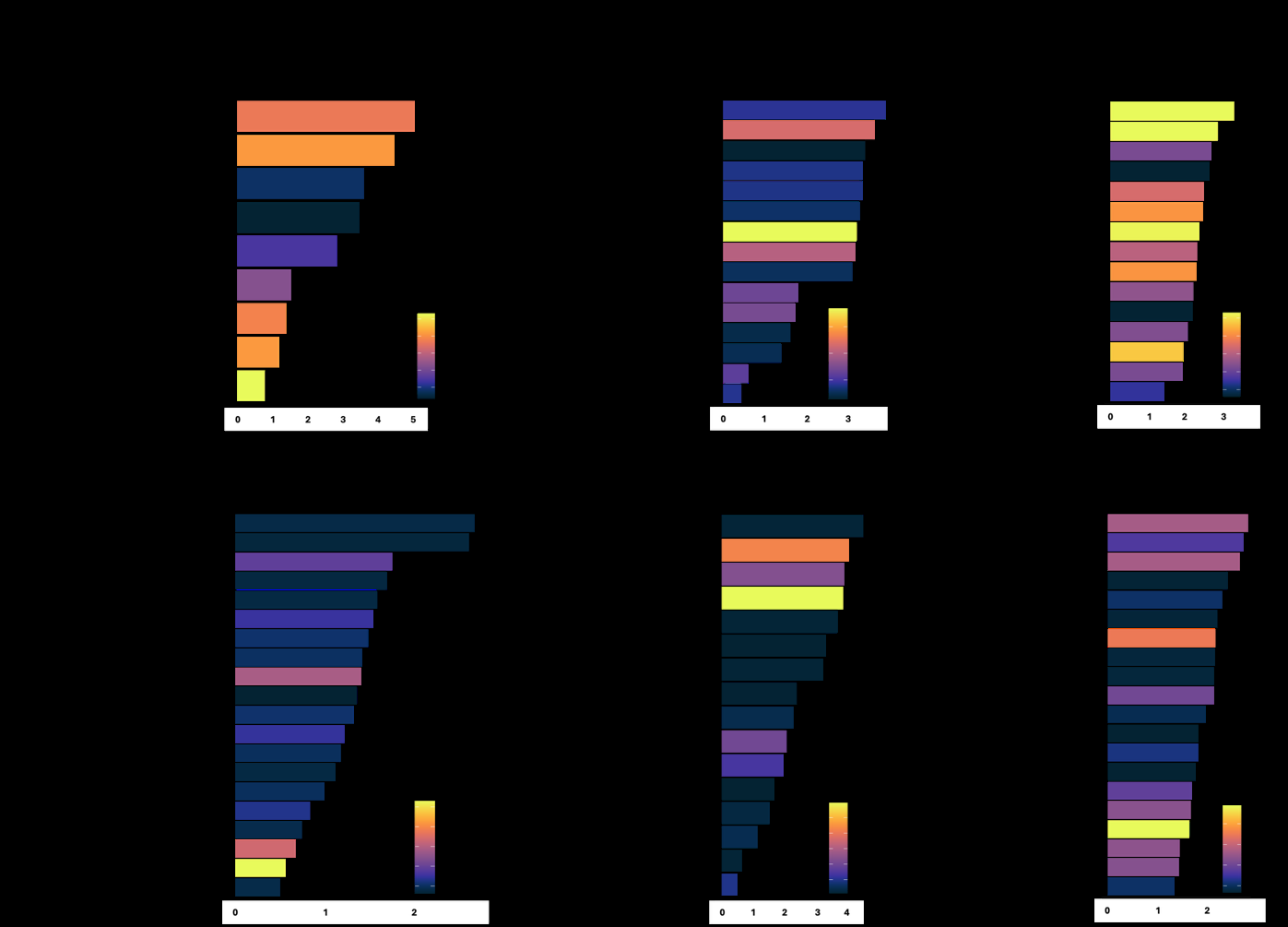
GO enrichment demonstrated predominant downregulation of cellular components associated with the membrane–cytoskeletal interface , including plasma membrane, sarcolemma, lysosome, extracellular matrix, adherens and tight junctions, and actin-based structures at both E16.5 and E18.5 (Figure 6A, B; See Supplementary Tables S9–S14 for complete lists). These findings are consistent with Plac1 localization to membranous compartments, particularly at the apical trophoblast surface. Enrichment of midbody and spindle-associated structures suggested impaired cytokinesis, while prominent involvement of Weibel–Palade bodies at E16.5 indicated endothelial-specific dysfunction. Given their role in regulated release of von Willebrand factor, angiopoietin-2, and endothelin-1, reduced WP-associated signaling would be expected to compromise hemostasis, vascular tone, angiogenesis, and immune regulation at the maternal–fetal interface [91–93].
In contrast, upregulated cellular components reflected stress-adaptive and compensatory responses, most notably enrichment of translational machinery, ribonucleoprotein complexes, and ER/Golgi compartments, particularly at E18.5. These changes indicate increased translational load, secretory activity, and proteostasis demand under nutrient and oxidative stress. Immune-related components also showed progressive enrichment, shifting from MHC class I and cytotoxic signaling at E16.5 toward MHC class II–associated antigen presentation, phagocytic vesicles, and adaptive immune activation by E18.5. Additional enrichment of extracellular matrix and synapse-annotated compartments, likely reflecting vesicle trafficking and cytoskeletal remodeling rather than neuronal specificity, further supported widespread disruption of membrane dynamics and cell–cell communication.
Downregulated GO biological process analysis revealed significant suppression of growth factor and developmental signaling pathways, including BMP, FGF, Wnt, TGF-β, and Jak–STAT, all critical regulators of placental development. In addition, genes dysregulated in our placental dataset were significantly enriched for GO annotations related to embryonic organogenesis. Cardiovascular, neurodevelopmental, pulmonary, renal, and skeletal pathways were disproportionately affected, consistent with Plac1 expression in both the placenta and embryo and with documented neurodevelopmental vulnerability in Plac1-deficient models (See Supplementary Data, Tables S9–S14 for complete GO terms). GO Biological Process enrichment for upregulated genes at both E16.5 and E18.5 was represented by generalized immune, stress, and metabolic response terms that overlapped extensively with KEGG and IPA pathway annotations and is presented in full in the Supplementary Data (Tables S10, S13).
KEGG Analysis
KEGG analysis at E18.5 reinforced these findings, identifying coordinated downregulation of pathways governing vascular smooth muscle contraction, calcium and cGMP–PKG signaling, apelin signaling, tight junction integrity, TGF-β signaling, and Hippo pathway components at E18.5 (Figure 7; Supplementary Data, Tables S15–S19), collectively indicating impaired vascular remodeling, cytoskeletal organization, trophoblast proliferation, and structural stability. No significant downregulated KEGG terms were identified at E16.5.
Conversely, KEGG terms enriched among upregulated genes were dominated by cellular stress, metabolic adaptation, and immune activation , including Ribosome, Protein Processing in the Endoplasmic Reticulum, Glycolysis/Gluconeogenesis, Carbon Metabolism, Phagosome, and Antigen Processing and Presentation (Table 4; Supplementary Data, Tables S15–S19). Viral and inflammatory pathway annotations reflected heightened innate and adaptive immune signaling rather than pathogen-specific responses.
| KEGG Term | E16.5 Fold Enrichment | E16.5 FDR | E18.5 Fold Enrichment | E18.5 FDR |
|---|---|---|---|---|
| Ribosome | 6.36 | 4.16E-16 | 9.38 | 3.02E-45 |
| Coronavirus Disease-COVID 19 | 4.87 | 3.26E-12 | 6.88 | 5.71E-36 |
| Glycolysis/Gluconeoneogenesis | 5.75 | 8.95E-04 | — | — |
| Antigen processing/presentation | 4.84 | 1.06E-03 | — | — |
| Allograft rejection | 5.55 | 1.60E-03 | — | — |
| Graft versus host disease | 5.55 | 1.60E-03 | — | — |
| Type I diabetes mellitus | 4.94 | 4.12E-03 | — | — |
| Biosynthesis of amino acids | 4.46 | 7.31E-03 | — | — |
| Autoimmune thyroid disease | 4.33 | 7.31E-03 | — | — |
| Carbon metabolism | 3.66 | 7.41E-03 | — | — |
| Pentose phosphate pathway | 6.51 | 7.41E-03 | — | — |
| Viral myocarditis | 3.82 | 1.42E-02 | — | — |
| Amino and nucleotide sugar metabolism | 5.67 | 1.76E-02 | — | — |
| Phagosome | 2.91 | 2.0E-02 | — | — |
| Cell adhesion molecules | 2.87 | 2.2E-02 | — | — |
| HIF-1 signaling pathway | 3.36 | 2.6E-02 | — | — |
| VEGF signaling pathway | 4.36 | 3.1E-02 | — | — |
| Epstein-Barr virus infection | 2.52 | 3.93E-02 | — | — |
| Fructose and mannose metabolism | 5.13 | 4.37E-02 | — | — |
| Biosynthesis of nucleotide sugars | 4.99 | 4.97E-02 | 4.63 | 4.98E-02 |
| Protein Processing in ER | — | — | 2.7 | 3.80E-02 |
| Amoebiasis | — | — | 3.09 | 4.98E-02 |
| Cellular senescence | 2.65 | 4.97E-02 | — | — |
Table 4. KEGG Analysis of Upregulated Genes
References (continued)
Gu J, Gao F, Hübner R, Schlessinger D, Rao SN. PLAC1, a Novel Placental Gene with ZP3-Domain Structure, Shows Placenta-Specific Expression. Ann N Y Acad Sci. 2000 May;906:63-72. doi: 10.1111/j.1749-6632.2000.tb06597.x. PMID: 10854339.
Kammerer R, Buchberger A, Straub B, Zimmermann W. Identification of a fourth member of the carcinoembryonic antigen family. J Biol Chem. 1998 Dec 18;273(51):34392-9. doi: 10.1074/jbc.273.51.34392. PMID: 9852107.
Choo KB, Reddy KV, Murthy GS, Singh RP. Molecular evidence for embryonal carcinoma antigen in the mouse trophoblast. Placenta. 2002;23(8-9):671-8. doi: 10.1053/plac.2002.0844. PMID: 12361684.
Haspel HC, Rosenfeld RG, Rahilly-Tierney B, et al. Insulin-like growth factor I mediates the differentiation of human placental trophoblasts. J Clin Endocrinol Metab. 1989 Apr;68(4):699-705. doi: 10.1210/jcem-68-4-699. PMID: 2494098.
Soleymanlou N, Jurisica I, Nevo O, Ietta F, Zhang X, Zamudio S, Post M, Caniggia I. Molecular evidence of placental hypoxia in preeclampsia. J Clin Invest. 2005 Dec;115(12):3468-72. doi: 10.1172/JCI25498. PMID: 16284649; PMCID: PMC1297268.
Jauniaux E, Poston L, Burton GJ. Placental-related diseases of pregnancy: involvement of oxidative stress and implications for management. Am J Pathol. 2006 Dec;169(6):2099-112. doi: 10.2353/ajpath.2006.060583. PMID: 17148675; PMCID: PMC1698856.
Huppertz B. Placental origins of preeclampsia: challenging the current hypothesis. Hypertension. 2008 Apr;51(4):970-5. doi: 10.1161/HYPERTENSIONAHA.107.107896. PMID: 18259009.
Redman CW, Sargent IL. Latest advances in understanding preeclampsia. Science. 2005 Jun 10;308(5728):1592-4. doi: 10.1126/science.1111726. PMID: 15947178.
Burton GJ, Redman CW, Roberts JM. Pre-eclampsia: pathophysiology and clinical implications. BMJ. 2019 Jun 19;365:l2382. doi: 10.1136/bmj.l2382. PMID: 31217195.
Foidart JM, Schaaps JP, Chantraine F, Munaut C, Schwers J. Dysregulation of anti-angiogenic agents (anti-VEGF, anti-PlGF) in preeclampsia. Semin Reprod Med. 2009 Sep;27(5):383-91. doi: 10.1055/s-0029-1237431. PMID: 19790029.
Maynard SE, Min JY, Merchan J, et al. Excess placental soluble fms-like tyrosine kinase 1 (sFlt1) may contribute to endothelial dysfunction, hypertension, and proteinuria in preeclampsia. J Clin Invest. 2003 Mar;111(5):649-58. doi: 10.1172/JCI17189. PMID: 12618519; PMCID: PMC151884.
Venkatesha S, Toporsian M, Lecker C, et al. Soluble endoglin contributes to the pathogenesis of preeclampsia. Nat Med. 2006 Jun;12(6):642-9. doi: 10.1038/nm1429. PMID: 16751768.
Roberts JM, Hubel CA. The two stage model of preeclampsia: variations on the theme. Placenta. 2009 Aug;30 Suppl A:S32-7. doi: 10.1016/j.placenta.2008.11.009. PMID: 19070360; PMCID: PMC2748541.
Lim JH, Kim SY, Park SY, Oh SJ, Kim MJ, Park SH, Ryu HS. Systemic inflammation marker and endothelial dysfunction in preeclampsia. Gynecol Obstet Invest. 2008;66(4):203-8. doi: 10.1159/000149749. PMID: 18594140.
Adegoke SA, Adeyemi AS, Alawode AT. Systemic inflammatory markers and endothelial dysfunction in preeclampsia. West Afr J Med. 2014 Oct-Dec;33(4):257-62. PMID: 25586205.
Sargent IL, Borzychowski AM, Redman CW. Immunology of normal pregnancy. Semin Immunol. 2006 Apr;18(2):87-100. doi: 10.1016/j.smim.2006.01.005. PMID: 16516534.
Redman CW, Sacks GP, Sargent IL. Preeclampsia: an excessive maternal inflammatory response to pregnancy. Am J Obstet Gynecol. 1999 Feb;180(2 Pt 1):499-506. doi: 10.1016/s0002-9378(99)70239-1. PMID: 9988826.
Luppi P, Tafuri A, Haluszczak C, Trucco M. Tracking the immunological changes in preeclampsia. Am J Reprod Immunol. 2002 Feb;47(2):87-96. doi: 10.1034/j.1600-0897.2002.1o028.x. PMID: 12074553.
Nagamatsu T, Schust DJ. The immunomodulatory role of placental exosomes in pregnancy and preeclampsia. Front Immunol. 2019 May 28;10:1145. doi: 10.3389/fimmu.2019.01145. PMID: 31191480; PMCID: PMC6546872.
Galinelli de Souza R, Santana TM, de Oliveira-Neto OL, Belo VA, Goulart LR, Diniz SO, Teixeira AL, Teixeira MM. Circulating soluble TRAIL and death receptor expression on peripheral lymphocytes are associated with gestational hypertension and preeclampsia. J Reprod Immunol. 2016 Sep;117:64-73. doi: 10.1016/j.jri.2016.07.001. PMID: 27421456.
Bánhidy F, Acs N, Puhó EH, Czeizel AE. Maternal serum alpha-fetoprotein level as risk indicator of preeclampsia. Arch Gynecol Obstet. 2006 Feb;273(6):346-51. doi: 10.1007/s00404-005-0079-x. PMID: 16136305.
Grill S, Rusterholz C, Zanetti-Dällenbach R, et al. Potential markers of preeclampsia — a review. Reprod Sci. 2009 Jun;16(6):671-83. doi: 10.1177/1933719109332265. PMID: 19258296.
Chutkow WA, Palade PT, Baudet S, et al. Effects of contractile activity on subcellular localization of glucose transporters and glycogen in rat skeletal muscle. J Biol Chem. 1992 Oct 25;267(30):21500-6. PMID: 1400458.
Ito H, Kanbe S, Saito H, Nozaki T, Kawahara Y, Miyagawa JI, Ando K, Inoue S, Shimura H, Masuda T. Fibronectin and pregnancy: role of pregnancy-associated glycosylated fibronectin in the diagnosis of preeclampsia. Am J Obstet Gynecol. 1993 Jun;168(6 Pt 1):1797-804. doi: 10.1016/0002-9378(93)90735-u. PMID: 8317523.
Ismail MA, Brizot ML, Sahin M, Ville Y, Antsaklis A, Ergür AR, Yücel K, Oztürk U, Çiftçi B, Kuscu NK. Glycosylated fibronectin and pregnancy-associated plasma protein-A (PAPP-A) at 11-13 weeks gestation in the prediction of severe preeclampsia. Fetal Diagn Ther. 2016;39(2):88-95. doi: 10.1159/000440817. PMID: 26272090.
Bahado-Singh RO, Akolekar R, Chelliah A, Dastgiri S, Prefumo F, Zadora P, Thilaganathan B. Placental volume at 11-13 weeks’ gestation in preeclampsia. Ultrasound Obstet Gynecol. 2013 Oct;42(4):411-8. doi: 10.1002/uog.12508. PMID: 23754421.
Cowans NJ, Stamatopoulou A, Maiz N, Spencer K, Nicolaides KH. Mid-trimester maternal serum markers for prediction of preeclampsia in women with assisted conception. Prenat Diagn. 2011 May;31(5):479-86. doi: 10.1002/pd.2719. PMID: 21465531.
Kempley ST, Gamsu HR. Preeclampsia is associated with a reduced trophoblastic invasion of vessels in the placental bed. J Perinat Med. 2002;30(2):169-79. doi: 10.1515/jpm.2002.024. PMID: 12139762.
Jauniaux E, Hempstock J, Teng C, Battaglia FC, Burton GJ. Polyol accumulation in pre-eclamptic placenta. Placenta. 2005 Aug-Sep;26(8-9):696-702. doi: 10.1016/j.placenta.2004.09.017. PMID: 15993704.
Ahmed A, Li XF, Ali S, Shaw L. Induction of paladin expression enhances trophoblast cell invasion and differentiation. Biol Reprod. 2006 Dec;75(6):847-57. doi: 10.1095/biolreprod.106.054742. PMID: 16957024.
Hiby SE, Walker JJ, O’Shaughnessy KM, Redman CW, Carrington M, Trowsdale J, Moffett A. Combinations of maternal KIR and fetal HLA-C genes influence the risk of preeclampsia and reproductive success. J Exp Med. 2004 Oct 18;200(8):957-65. doi: 10.1084/jem.20040547. PMID: 15477526; PMCID: PMC2211853.
Yamada H, Kato EH, Ebina Y, Shimada S, Nishizuka M, Morikawa M, Iwabuchi K, Kishi R, Umesaki N, Furuta R. Gene polymorphism associated with natural killer cell killing activity and adverse pregnancy outcome. J Reprod Immunol. 2007 Nov;75(2):106-14. doi: 10.1016/j.jri.2007.05.005. PMID: 17581603.
Livak KJ, Schmittgen TD. Analysis of relative gene expression data using real-time quantitative PCR and the 2(-Delta Delta C(T)) Method. Methods. 2001 Dec;25(4):402-8. doi: 10.1006/meth.2001.1262. PMID: 11846609.
Gentleman RC, Carey VJ, Bates DM, et al. Bioconductor: open software development for computational biology and bioinformatics. Genome Biol. 2004;5(10):R80. doi: 10.1186/gb-2004-5-10-r80. PMID: 15461798; PMCID: PMC545600.
Ashburner M, Ball CA, Blake JA, et al. Gene ontology: tool for the unification of biology. Nat Genet. 2000 May;25(1):25-9. doi: 10.1038/75556. PMID: 10802651; PMCID: PMC3037419.
Kanehisa M, Goto S. KEGG: kyoto encyclopedia of genes and genomes. Nucleic Acids Res. 2000 Jan 1;28(1):27-30. doi: 10.1093/nar/28.1.27. PMID: 10592173; PMCID: PMC102409.
Krämer A, Green J, Pollard J Jr, Tugendreich S. Causal analysis approaches in Ingenuity Pathway Analysis. Bioinformatics. 2014 Apr 15;30(4):523-30. doi: 10.1093/bioinformatics/btt386. Epub 2013 Nov 14. PMID: 24336805; PMCID: PMC3966700.
Benjamini Y, Hochberg Y. Controlling the false discovery rate: a practical and powerful approach to multiple testing. J R Stat Soc Series B Stat Methodol. 1995;57(1):289-300.
Piñero J, Ramírez-Anguita JM, Saüch-Pitarch J, et al. DisGeNET: a comprehensive platform integrating information on human disease-associated genes and variants. Nucleic Acids Res. 2020 Jan 8;48(D1):D677-D688. doi: 10.1093/nar/gkz1021. PMID: 31680692; PMCID: PMC7145624.
Safran M, Dalah I, Alexander J, et al. GeneCards Version 3: the human gene integrative information database. Nucleic Acids Res. 2010 Jan;38(Database issue):D142-8. doi: 10.1093/nar/gkp987. Epub 2009 Oct 8. PMID: 19829691; PMCID: PMC2808881.
Jäger S, Cimermancic P, Gulbahce N, Johnson JR, McGovern KE, Clarke SC, Shales M, Mercenne G, Pache L, Li K, Hernandez H, Jang GM, Roth SL, Akiva E, Marlett J, Marshall B, Rooney A, Lopes JF, Tsversky JJ, Wüthrich K, Verschueren E, Reja R, Garcia-Sastre A, Maufoux F, Time A, Oh S, Perch M, Ramírez JD, Duggineni S, Kuhn JH, Chanda SK, Sali A, Andersen KG, Krogan NJ. Global landscape of HIV-human protein interaction networks. Nature. 2012 Jul 12;487(7406):169-75. doi: 10.1038/nature11273. PMID: 22798687; PMCID: PMC3572185.
Rho GTPase Cycle. In: Ingenuity Knowledge Base. Ingenuity Systems; https://www.ingenuity.com .
Hodges AK, Watkins H. Regulatory roles of small RhoGTPases in the heart. Cardiovasc Res. 2012 Feb 1;93(2):290-8. doi: 10.1093/cvr/cvr327. PMID: 22038743.
Arthur WT, Burridge K. RhoA inactivation by p190RhoGAP regulates cell spreading and migration by promoting membrane protrusion and polarity. Mol Biol Cell. 2001 Sep;12(9):2711-20. doi: 10.1091/mbc.12.9.2711. PMID: 11553712; PMCID: PMC60056.
Jaffe AB, Hall A. Rho GTPases: biochemistry and biology. Annu Rev Cell Dev Biol. 2005;21:247-69. doi: 10.1146/annurev.cellbio.21.020604.150721. PMID: 16212495.
Aktories K, Hall A. Bacterial toxins and the Rho GTPase signaling pathway. Exp Cell Res. 1989 Jan;180(1):35-46. doi: 10.1016/0014-4827(89)90318-0. PMID: 2464946.
Ellerbroek SM, Wennerberg K, Arthur WT, Dunty JM, Bowman DR, DeMali KA, Burridge K. LARG, a novel Arf-GAP, interacts with IQGAP1 and modulates Rac1 signaling. J Cell Biol. 2003 May 12;161(3):467-76. doi: 10.1083/jcb.200210103. PMID: 12732614; PMCID: PMC2172936.
Wennerberg K, Forget MA, Ellerbroek SM, Arteaga CL, Burridge K, Settleman J. Rnd proteins function as RhoA antagonists by activating p190 RhoGAP. Proc Natl Acad Sci USA. 2003 Dec 9;100(25):15061-6. doi: 10.1073/pnas.2536359100. PMID: 14654140; PMCID: PMC299869.
Mammoto A, Huang S, Moore K, Oh P, Dupont KM, KOriginal A, Ingber DE. Role of RhoA, mDia, and ROCK in cell morphogenesis and force generation for differentiation of C2C12 myoblasts. Am J Physiol Cell Physiol. 2007 Oct;293(4):C1602-11. doi: 10.1152/ajpcell.00288.2007. Epub 2007 Aug 1. PMID: 17681941.
Neth P, Ries C, Karow M, Hegen A, Korbmacher C, Egea V, Knoss P, Samstag Y, Orfanos CE, Thewes M, Gerdes J. Rho/ROCK signaling is critical for formation of the blood-brain barrier in vivo. J Neurochem. 2007 Sep;102(5):1538-50. doi: 10.1111/j.1471-4159.2007.04660.x. PMID: 17680979.
Chrzanowska-Wodnicka M, Burridge K. Rho-stimulated contractility drives the formation of stress fibers and focal adhesions. J Cell Biol. 1996 Apr;133(2):457-67. doi: 10.1083/jcb.133.2.457. PMID: 8609174; PMCID: PMC2120881.
Ridley AJ, Hall A. The small GTP-binding protein rho regulates the joining of focal adhesions and actin stress fibers in response to growth factors. Cell. 1992 Aug 21;70(3):389-99. doi: 10.1016/0092-8674(92)90163-7. PMID: 1643658.
Parri M, Chiarugi P. Rac and Rho GTPases as regulators of cell migration in three-dimensional environments. J Cell Sci. 2010 Apr 1;123(Pt 7):1149-60. doi: 10.1242/jcs.074559. PMID: 20356928.
Zheng Y. Dbl family GEFs. Trends Biochem Sci. 2001 May;26(5):310-4. doi: 10.1016/s0968-0004(01)01810-3. PMID: 11343924.
Barry FM, Gibb BJ, Hope HR, Poutney DL, Brown AD. The guanine-nucleotide exchange factor DBL-1 is a cytoplasmic protein associated with the actin cytoskeleton. J Biol Chem. 1997 Sep 5;272(36):22499-504. doi: 10.1074/jbc.272.36.22499. PMID: 9278397.
Collins DP, Barker SA, Sluczewski JM, Lantz MS, Hare RS, McIntyre TM, Zimmerman GA, Prescott SM. Regulated expression and activation of Ras proteins in T lymphocytes. J Biol Chem. 1992 Dec 25;267(36):25697-704. PMID: 1464589.
Kaur H, Sprung CN, Meyn RE, Khanna KK. Chemotherapy targeting of DNA repair in mammalian cells. Clin Cancer Res. 2005 Feb 1;11(3):1072-8. PMID: 15709172.
Raftopoulou M, Hall A. Cell migration: Rho GTPases lead the way. Dev Biol. 2004 Apr 15;265(1):23-32. doi: 10.1016/j.ydbio.2003.06.002. PMID: 15147374.
Bhattacharya S, Schmoker B, Sperlich B, Warnecke G, Sinha B, Kreutz W, Srivastava KC. Myocardin–a regulator of smooth muscle cell differentiation and a novel tumor suppressor. FEBS Lett. 2004 May 21;566(1-3):115-9. doi: 10.1016/j.febslet.2004.03.090. PMID: 15147878.
Wang DZ, Li S, Regulski M, Richardson DA, Bash O, Olson EN, Wang Z. Signal-dependent recruitment of coactivators to the cardiac Myocardin promoter. Mol Cell Biol. 2001 Oct;21(20):6898-907. doi: 10.1128/MCB.21.20.6898-6907.2001. PMID: 11564873; PMCID: PMC99927.
Yoshida T, Sinha S, Dandre F, Wamhoff BR, Hoofnagle MH, Kremer BE, Wang DZ, Olson EN, Owens GK. Myocardin is a key regulator of CArG-dependent waveform-dependent expression of contractile protein genes in aortic smooth muscle cells. Circ Res. 2003 Aug 22;93(4):365-72. doi: 10.1161/01.RES.0000087641.28073.09. PMID: 12893743.
Clapham DE. Calcium signaling. Cell. 2007 Dec 14;131(6):1047-58. doi: 10.1016/j.cell.2007.11.028. PMID: 18083096.
Gao S, Zhou M, Sheng Y, Zhang X, Gao Y, Zhang Y, Jiang H, Qin L, Luo Y. Effects of bone morphogenetic protein 6 on commitment of human bone marrow mesenchymal stem cells. Tissue Eng Part A. 2012 Jan;18(1-2):174-85. doi: 10.1089/ten.tea.2011.0322. Epub 2011 Nov 18. PMID: 21939335.
Harding HP, Zhang Y, Zeng H, Novoa I, Lu PD, Calfon M, Sadri N, Yun C, Popko B, Paules R, Stojdl DF, Bell JC, Hettmann T, Leiden JM, Ron D. An integrated stress response regulates amino acid metabolism and resistance to oxidative stress. Mol Cell. 2003 Apr;11(3):619-33. doi: 10.1016/s1097-2765(03)00105-9. PMID: 12667446.
Hinnebusch AG. Translational regulation of GCN4 by protein kinase GCN2. J Biol Chem. 1994 Dec 23;269(51):32480-5. PMID: 7798245.
Ron D, Walter P. Signal integration in the endoplasmic reticulum unfolded protein response. Nat Rev Mol Cell Biol. 2007 Jul;8(7):519-29. doi: 10.1038/nrm2199. PMID: 17565364.
Wek RC, Jiang HY, Anthony TG. Cationic amino acid transport and endoplasmic reticulum stress regulate CHOP translation via the upstream open reading frames. J Biol Chem. 2006 Sep 22;281(38):28529-38. doi: 10.1074/jbc.M606541200. Epub 2006 Jul 14. PMID: 16867997.
Holcik M, Sonenberg N. Translational control from 5’ UTRs and IRESs: When upstream open reading frames get in the way. J Cell Biol. 2005 Aug 1;170(3):367-74. doi: 10.1083/jcb.200505124. PMID: 16043513; PMCID: PMC2171442.
Bellot G, Garcia-Medina R, Gould P, Cardinal M, Wodarz D, Michor F. A high-citrate diet sustains tolerance to 5-fluorouracil in colorectal cancer. Nature. 2015 Dec 3;528(7581):S102-8. doi: 10.1038/nature15373. PMID: 26633759; PMCID: PMC4694990.
Anderson P, Kedersha N. Stress granules: the Tls story. Trends Biochem Sci. 2008 Mar;33(3):141-50. doi: 10.1016/j.tibs.2007.12.003. PMID: 18291657.
Anderson P, Phillips C. Post-transcriptional gene regulation by long non-coding RNAs. RNA Biol. 2012 Jan;9(1):6-13. doi: 10.4161/rna.18482. Epub 2012 Jan 1. PMID: 22212869; PMCID: PMC3357438.
Cohen-Cory S, Kidane AH, Shirkey NJ, Marshak S. Brain-derived neurotrophic factor and the developing nervous system: role in synaptic plasticity and behavior. Neuroscientist. 2010 Dec;16(6):638-56. doi: 10.1177/1073858410386092. PMID: 20817842; PMCID: PMC3076755.
Kenwrick S, Watkins A, De Angelis E. Beta-dystroglycan, a regulator of the dystrophin-associated protein complex. Neuromuscul Disord. 2000 Jun;10(4-5):255-63. doi: 10.1016/s0960-8966(00)00108-2. PMID: 10899443.
Mahoney WM Jr, Hong JH, Yaffe MB, Farrance IK. The transcriptional co-activator TAZ interacts differentially with transcription factors. J Biol Chem. 2005 Mar 18;280(11):10776-86. doi: 10.1074/jbc.M411591200. Epub 2005 Jan 24. PMID: 15657050.
van Duijnhoven G, Robanus-Maandag E, Krimpenfort P, Deschamps J, Sofroniew M, Jaenisch R, berns A. Lymphomas in T-cell specific PML-RARA transgenic mice. Oncogene. 1994 Dec 1;9(11):3215-25. PMID: 7969348.
Harris KP, Aronova A, Macara IG. Par3 controls centrosomal positioning in epithelia by negatively regulating Par6-aPKC-dependent Cdc42 recruitment to the apical membrane. Curr Biol. 2016 Aug 22;26(16):2188-2200. doi: 10.1016/j.cub.2016.06.072. Epub 2016 Aug 4. PMID: 27508173; PMCID: PMC4992916.
Mancusso R, Gregorio GG, Liu Q, Wang DN. Structure and mechanism of a bacterial sodium-dependent dicarboxylate transporter. Nature. 2012 Jan 1;491(7424):622-6. doi: 10.1038/nature11542. PMID: 23086149; PMCID: PMC3355215.
Shimojo M, Khokhlatchev A, Hashimoto N, et al. A rapid turnover cycle for the MAPK cascade kinases Mek1 and Mek2. Proc Natl Acad Sci USA. 2000 Nov 7;97(23):12614-9. doi: 10.1073/pnas.220304097. PMID: 11050185; PMCID: PMC18784.
Roy S, Gao F, Meisler MH, Iadecola C, Gidday JM. ApoE-based coreceptor activity is required for dendritic cell migration, but not for homing of neural precursors in the brain. J Neurosci. 2005 May 25;25(21):5103-10. doi: 10.1523/JNEUROSCI.0910-05.2005. PMID: 15917451; PMCID: PMC6725244.
Meriluoto J, Codd GA, Eriksson JE. Toxicology of cyanobacteria. In: Cyanobacterial Toxins. Springer; 2005. p. 41-111.
Chou JY, Matern D, Mansfield BC, Chen YT. Type I glycogen storage diseases: disorders of the glucose-6-phosphatase complex. Curr Mol Med. 2002 Mar;2(2):121-43. doi: 10.2174/1566524024605753. PMID: 11949130.
Katz SG, Whitmire BA, Gupta S, Katz NR. Morphogenesis and the role of Rho GTPases. Adv Genet. 2013;84:117-55. doi: 10.1016/B978-0-12-407703-4.00004-7. PMID: 23886032.
Kowalczyk AP. The cytoplasmic domain of desmogleins. In: Desmosomes and Disease. Springer; 2006. p. 75-100.
McNeil PL, Vogel SS, Miyake K, Terasaki M. Patching plasma membrane disruptions with cytoplasmic membrane. J Cell Sci. 2000 Jun;113 Pt 11:1891-902. PMID: 10806097.
Zhang Y, Kang SA, Mukherjee S, Holowka D, Baird B, Crafton EB, Liwang PJ, Pierce SK, Liu W, Zhu P, Goldstein B. B cell receptor engagement by SAP-containing bivalent ligand induces apoptosis in B cells. J Biol Chem. 2000 Jul 7;275(27):20850-9. doi: 10.1074/jbc.M000698200. PMID: 10875928.
Coussens LM, Fingleton B, Matrisian LM. Matrix metalloproteinase inhibitors and cancer: trials and tribulations. Science. 2002 Aug 2;297(5583):821-4. doi: 10.1126/science.297.5583.821. PMID: 12161670.
Stepp MA, Urry Z, Hynes RO. Disruption of focal adhesions in cells lacking talin. J Cell Biol. 1994 Jan;124(2):203-13. doi: 10.1083/jcb.124.2.203. PMID: 8294496; PMCID: PMC2119930.
Schuler M, Bossy-Wetzel E, Goldstein JC, Fitzgerald P, Green DR. p53 induces apoptosis by caspase activation through mitochondrial cytochrome c release. J Biol Chem. 2000 Mar 24;275(12):7337-42. doi: 10.1074/jbc.275.12.7337. PMID: 10702305.
Chao DT, Korsmeyer SJ. BCL-2 family: regulators of cell death. Annu Rev Immunol. 1998;16:395-419. doi: 10.1146/annurev.immunol.16.1.395. PMID: 9597135.
Ashkenazi A, Dixit VM. Death receptors: signaling and modulation. Science. 1998 Aug 28;281(5381):1305-8. doi: 10.1126/science.281.5381.1305. PMID: 9721089.
Labeit D, Kolmerer B, Linke WA. COOH-terminal S/T modular element is essential for the elasticity of nebulin. J Biol Chem. 1997 Apr 18;272(16):10376-89. doi: 10.1074/jbc.272.16.10376. PMID: 9099681.
Linke WA, Kulke M, Li H, Fujita-Becker S, Neagoe C, Manstein DJ, Gautel M, Fernandez JM. PEVK domain of titin: an entropic spring with actin- and myosin-binding properties. J Biol Chem. 2002 Jan 11;277(2):1273-82. doi: 10.1074/jbc.M107006200. PMID: 11696547.
Linke WA, Ivemeyer M, Mundel P, Stockmeier MR, Kolmerer B. Nature of PEVK-titin elasticity in skeletal muscle. Proc Natl Acad Sci USA. 1998 Jul 7;95(14):8052-7. doi: 10.1073/pnas.95.14.8052. PMID: 9653140; PMCID: PMC20946.
Joubert F, Garbazza C, Ouared N, Braun S, Sormani O, Khoris J, Carty J, Konopacki FA, Seibt J, Okazaki-Hashino A, Gorce M, Broyer C, Chabot CC, Maulay-Smith F, Geay Y, Li H, Roberts C, Kauder K, Chandra L, Lewin GR. Trophoblast cell senescence is associated with reduced placental function in intrauterine growth restriction. Nat Commun. 2016 Oct 6;7:12913. doi: 10.1038/ncomms12913. PMID: 27708263; PMCID: PMC5055558.
Hoover PA, Blanton RL, Zeller FK, Barksdale AK, Cummings OW. Integrins in neoplastic mast cells of mastocytosis. J Cutan Pathol. 2000 Mar;27(3):126-32. doi: 10.1034/j.1600-0560.2000.027003126.x. PMID: 10883718.
Hall A. Rho family GTPases. Biochem Soc Trans. 2012 Dec 1;40(6):1378-82. doi: 10.1042/BST20120103. PMID: 23176484.
Symons M, Settleman J. Rho family GTPases: more than simple switches. Trends Cell Biol. 2000 Oct;10(10):415-9. doi: 10.1016/s0962-8924(00)01822-6. PMID: 10998601.
Huangfu D, Anderson KV. Signaling from Smo to Ci/Gli: conservation and divergence of Hedgehog pathways from Drosophila to vertebrates. Development. 2006 Jan;133(1):3-13. doi: 10.1242/dev.02169. PMID: 16339189.
Hahn H, Wicking C, Zaphiropoulos PG, et al. Mutations of the human homolog of Drosophila patched in the Gorlin syndrome. Cell. 1996 Jun 14;85(6):841-51. doi: 10.1016/s0092-8674(00)81268-4. PMID: 8681379.
Härtl D, Huber R, Buchner J. Molecular chaperones in protein folding and proteostasis. Nature. 2011 May 26;473(7348):484-9. doi: 10.1038/nature10317. PMID: 21614075.
Katsuta H, Akashi H, Katsuta R, Makino T, Uchida Y, Niijima A. Hepatic branch of the abdominal vagus nerve: electrophysiological and anatomical study in the rat. J Auton Nerv Syst. 2000 Oct 2;83(2-3):106-13. doi: 10.1016/s0165-1838(00)00158-0. PMID: 11027275.
Parsons SJ, Parsons JT. Src family kinases, key regulators of signal transduction. Oncogene. 2004 Oct 18;23(48):7906-9. doi: 10.1038/sj.onc.1208160. PMID: 15489910.
Boucheix C, Rubinstein E. Tetraspanins. Cell Mol Life Sci. 2001 Jul;58(7):1189-205. doi: 10.1007/pl00000933. PMID: 11577980.
Hemler ME. Tetraspanin functions and associated microdomains. Nat Rev Mol Cell Biol. 2005 Oct;6(10):801-11. doi: 10.1038/nrm1736. PMID: 16314868.
Zoller M. Tetraspanins: push and pull in suppressing and promoting metastasis. Nat Rev Cancer. 2009 Jan;9(1):40-55. doi: 10.1038/nrc2543. PMID: 19078974.
Stipp CS, Kolesnikova TV, Hemler ME. Functional domains in tetraspanin proteins. Trends Biochem Sci. 2003 Feb;28(2):106-12. doi: 10.1016/S0968-0004(03)00003-3. PMID: 12575537.
Kovalenko OV, Yang X, Kolesnikova TV, Hemler ME. A novel cysteine cross-link encircles the extracellular domains of tetraspanin CD82. J Biol Chem. 2000 Feb 25;275(8):5390-5. doi: 10.1074/jcb.275.8.5390. PMID: 10681511.
Barker DJ, Osmond C, Winter PD, Margetts B, Simmonds SJ. Weight in infancy and death from ischaemic heart disease. Lancet. 1989 Sep 9;2(8663):577-80. doi: 10.1016/s0140-6736(89)90710-1. PMID: 2570282.
Davey Smith G, Forrest AM, Kinsey RW. Optimal perinatal risk reduction. Lancet. 1997 May 3;349(9061):1289-93. doi: 10.1016/S0140-6736(96)07372-5. PMID: 9142060.
Levine RJ, Maynard SE, Qian C, et al. Circulating angiogenic factors and the risk of preeclampsia. N Engl J Med. 2004 Feb 12;350(7):672-83. doi: 10.1056/NEJMoa031884. PMID: 14764923.
Tjoa ML, Spinnato JA, Garzetti GG, Bahado-Singh RO. Angiotensin II type 1 receptor autoantibodies in preeclampsia. Hypertension. 2002 Aug;40(2):135-40. doi: 10.1161/01.hyp.0000024325.69045.2f. PMID: 12154102.
Verlohren S, Galindo A, Schlembach D, et al. An automated method for the determination of the sFlt-1/PlGF ratio in the assessment of preeclampsia. Am J Obstet Gynecol. 2010 May;202(5):473.e1-11. doi: 10.1016/j.ajog.2010.01.012. PMID: 20223446.
Wikstrom AK, Larsson A, Olovsson M, Engstrom G, Persson S, Berzu G, Sibai B. Placental growth factor and vascular endothelial growth factor levels in relation to placental abruption and preeclampsia: a longitudinal study. BJOG. 2010 Sep;117(10):1069-76. doi: 10.1111/j.1471-0528.2010.02638.x. PMID: 20618318.
Simonazzi G, Rizzo N, Prefumo F, Tiberti A, Olovsson M, Bergman L, Marini G, Ghi T, Pilu G. Maternal serum PAPP-A and free beta-hCG at 11-14 weeks in pregnancies complicated by preeclampsia or fetal growth restriction. BJOG. 2007 Jun;114(6):742-7. doi: 10.1111/j.1471-0528.2007.01324.x. PMID: 17516969.
Groom KM, McCowan LM, Poston L, Hanson MA, Chamley LW, Delivered On Time Collaborative Group. Enoxaparin for the prevention of preeclampsia and intrauterine growth restriction in women with previous preeclampsia: a pilot randomized controlled trial. Am J Obstet Gynecol. 2009 Sep;201(3):269.e1-9. doi: 10.1016/j.ajog.2009.06.021. Epub 2009 Aug 13. PMID: 19632646.
Chowdhury S, Thomaidou S, Davey M, Wicks M, Wood AM. The epidemiological association between birth weight, gestation and neonatal outcomes in the context of preeclampsia. Eur J Obstet Gynecol Reprod Biol. 2015 Aug;191:75-81. doi: 10.1016/j.ejogrb.2015.05.021. PMID: 26070236.
Duley L. The global impact of pre-eclampsia and eclampsia. Semin Perinatol. 2009 Jun;33(3):130-7. doi: 10.1053/j.semperi.2009.02.010. PMID: 19464502.
Steegers EA, von Dadelszen P, Duvekot JJ, Pijnenborg R. Pre-eclampsia. Lancet. 2010 Aug 21;376(9741):631-44. doi: 10.1016/S0140-6736(10)60279-6. PMID: 20598363.
Erez O, Romero R, Espinoza J, Fu W, Todem D, Kusanovic JP, Gotsch F, Edwin S, Nhan-Chang CL, Mittal P, Hassan SS, Draghici S. The change in concentrations of angiogenic and anti-angiogenic factors in maternal plasma between the first and second pregnancies in primiparous women who developed preeclampsia in the first pregnancy. J Matern Fetal Neonatal Med. 2011 Oct;24(10):1191-202. doi: 10.3109/14767058.2011.563646. Epub 2011 Sep 19. PMID: 21726203; PMCID: PMC3168276.
Cnossen JS, Morris RK, ter Riet G, Mol BW, van der Post JA, Coomarasamy A, Zwinderman AH, Robson SC, Titchener BA, Khan KS. Use of uterine artery Doppler ultrasonography to predict pre-eclampsia and intrauterine growth restriction: a systematic review and bivariable meta-analysis. CMAJ. 2008 Mar 11;178(6):701-11. doi: 10.1503/cmaj.070430. PMID: 18332385; PMCID: PMC2275181.
Roberts JM, Catov JM. Preeclampsia and cardiovascular disease after the index pregnancy. Semin Perinatol. 2016 Apr;40(3):126-32. doi: 10.1053/j.semperi.2015.12.001. PMID: 27016574; PMCID: PMC4869854.
Barker DJ. The developmental origins of adult disease. J Am Coll Cardiol. 2007 Oct 16;50(16):1579-89. doi: 10.1016/j.jacc.2007.02.045. PMID: 17936155.
Wadhwa PD, Buss C, Entringer S, Swanson JM. Developmental origins of health and disease: brief history and emerging focus. Semin Reprod Med. 2009 Sep;27(5):358-68. doi: 10.1055/s-0029-1237424. PMID: 19730960; PMCID: PMC2748525.
Koslowski M, Tureci O, Bell C, Krause P, Boesmans J, Salazar GP, Giese NA, Giese T, Einzelmann U, Designed U, Huber C, Castle JC. Multiple splice variants of the tumor-associated antigen PRAME are expressed in human cancers and originate from mutually exclusive exons. Cancer Res. 2007 May 1;67(9):4148-54. doi: 10.1158/0008-5472.CAN-06-4512. PMID: 17483325.
Vukovic B, Tanniger G, Lemmens G, Beheshti B, Chapman W, Squire JA, Zielenska M. Translocation (12;14)(q13;q31) in different types of tumors suggests a region(s) of oncogenic predisposition on chromosome 12q13. Genes Chromosomes Cancer. 1998 Mar;21(3):212-8. doi: 10.1002/(SICI)1098-2264(199803)21:3<212::AID-GCC3> 3.0.CO ;2-X. PMID: 9523185.
Pieta PG, Vomund S, Kreutz W. Angiogenic signaling in tumors. Adv Cancer Res. 2008;98:1-45. doi: 10.1016/S0065-9541(08)00401-1. PMID: 18772110.
Willms AB, Mulla MJ, Brosens JJ, Chamley LW, Salmon JE. Gestational diabetes mellitus as a model for studying interactions between immune and metabolic dysfunction. Semin Reprod Med. 2016 Apr;34(2):93-104. doi: 10.1055/s-0036-1572415. PMID: 27002631; PMCID: PMC4795842.
Trowsdale J, Betz AG. Mother’s little helpers: mechanisms of maternal-fetal tolerance. Nat Immunol. 2006 Mar;7(3):241-6. doi: 10.1038/ni1316. PMID: 16498432.
Capo-Chichi CD, Cai KQ, Testa JR, Godwin AK, Xu XX. Loss of GATA6 leads to nuclear deformation and aneuploidy in ovarian cancer. Mol Cell Biol. 2006 Dec;26(23):8882-91. doi: 10.1128/MCB.00579-06. PMID: 16982689; PMCID: PMC1636704.
Morey AL, Keramati MR, Nowell PC, Rowley JD. Rearrangement of the translin-associated factor X gene (TRAX) in the (X;11) translocation associated with infantile extraskeletal myxoid chondrosarcoma. Proc Natl Acad Sci USA. 1998 Sep 29;95(20):11781-5. doi: 10.1073/pnas.95.20.11781. PMID: 9751744; PMCID: PMC21721.
Carter GW, Haudenschild CD, Schafer S, Yoon BJ, Galas DJ. Prediction of genes regulating plants exposed to UV radiation. Physiol Plant. 2004 Dec;122(4):622-633. doi: 10.1111/j.1399-3054.2004.00434.x. PMID: 15658945.
Sharov AA, Maslov AY, Nishino K, Dawn B, Longo DL, Ko MSH. ExAtlas: an expression atlas resource for exploring and comparing gene expression across diverse cell types and developmental stages. Nucleic Acids Res. 2015 Jan;43(Database issue):D560-7. doi: 10.1093/nar/gku969. Epub 2014 Oct 10. PMID: 25313150; PMCID: PMC4383901.
Sharov AA, Nishino K, Longo DL, Ko MSH. Steady-state expression of 39,000+ genes in the mouse genome in fibroblasts and 10 other cell types derived from three tissues. Nucleic Acids Res. 2014 Jan;42(1):193-203. doi: 10.1093/nar/gkt1115. Epub 2013 Oct 25. PMID: 24151177; PMCID: PMC3904755.
Xu, J., Moore, B. N., & Pluznick, J. L. Short-Chain Fatty Acid Receptors and Blood Pressure Regulation: Council on Hypertension Mid-Career Award for Research Excellence 2021. Hypertension, 79(10), 2127–2137 (2022). doi: 10.1161/HYPERTENSIONAHA.122.18558
Pluznick, J. L., Protzko, R. J., Gevorgyan, H., Peterlin, Z., Sipos, A., Han, J., Brunet, I., Wan, L.X., Rey, F., Wang, T., et al. Olfactory receptor responding to gut microbiota-derived signals plays a role in renin secretion and blood pressure regulation. Proceedings of the National Academy of Sciences of the United States of America (PNAS), 110(11): 4410–4415 (2013). doi: 10.1073/pnas.1215927110
Dulac C, Torello AT. Molecular detection of pheromone signals in mammals: from genes to behaviour. Nat Rev Neurosci. 2003 Jul;4(7):551-62. doi: 10.1038/nrn1140. PMID: 12838330
Ransom LS, Liu CS, Dunsmore E, Palmer CR, Nicodemus J, Ziomek D, Williams N, Chun J. Human brain small extracellular vesicles contain selectively packaged, full-length mRNA. Cell Rep. 2024 Apr 23;43(4):114061. doi: 10.1016/j.celrep.2024.114061.
R. M. Popovici, M. Lu, S. Bhatia, G. H. Faessen, A. J. Giaccia, L. C. Giudice. Hypoxia Regulates Insulin-Like Growth Factor-Binding Protein 1 in Human Fetal Hepatocytes in Primary Culture: Suggestive Molecular Mechanisms for in Utero Fetal Growth Restriction Caused by Uteroplacental Insufficiency, The Journal of Clinical Endocrinology & Metabolism, Volume 86, Issue 6, 1 June 2001, Pages 2653–2659, https://doi.org/10.1210/jcem.86.6.7526
Choubey D, Duan X, Dickerson E, Ponomareva L, Panchanathan R, Shen H, Srivastava R. Interferon-inducible p200-family proteins as novel sensors of cytoplasmic DNA: role in inflammation and autoimmunity. J Interferon Cytokine Res. 2010 Jun;30(6):371-80. doi: 10.1089/jir.2009.0096. PMID: 20187776; PMCID: PMC2947464.
Hecht, J.L., Karumanchi, S.A. & Shainker, S.A. Immune cell infiltrate at the uteroplacental interface is altered in placenta accreta spectrum disorders. Arch Gynecol Obstet 301, 499–507 (2020). https://doi.org/10.1007/s00404-020-05453-1
Cai C, Tamai K, Molyneaux K. KHDC1B is a novel CPEB binding partner specifically expressed in mouse oocytes and early embryos. Mol Biol Cell. 2010 Sep 15;21(18):3137-48. doi: 10.1091/mbc.E10-03-0255. Epub 2010 Jul 28. PMID: 20668163; PMCID: PMC2938380.
The Human Protein Atlas. Expression of GABRQ in cancer. Available from: https://www.proteinatlas.org/ENSG00000268089-GABRQ/cancer
Zhuang B, Su YS, Sockanathan S. FARP1 promotes the dendritic growth of spinal motor neuron subtypes through transmembrane Semaphorin6A and PlexinA4 signaling. Neuron. 2009 Feb 12;61(3):359-72. doi: 10.1016/j.neuron.2008.12.022. PMID: 19217374; PMCID: PMC2654783.
Ho RX, Meyer RD, Chandler KB, Ersoy E, Park M, Bondzie PA, Rahimi N, Xu H, Costello CE, Rahimi N. MINAR1 is a Notch2-binding protein that inhibits angiogenesis and breast cancer growth. J Mol Cell Biol. 2018 Jun 1;10(3):195-204. doi: 10.1093/jmcb/mjy002. PMID: 29329397; PMCID: PMC6025234
Mouse Genome Informatics (MGI). Adipoq—adiponectin, C1Q and collagen domain containing (MGI:106675) [Internet]. The Jackson Laboratory; c1994–2026. available under aCC-BY 4.0 International license. Available from: https://www.informatics.jax.org/marker/MGI:106675 Accessed 2026 Feb 27.
Mouse Genome Informatics (MGI). B630019A10Rik (synonym: C730014E05Rik) (MGI:2443371) [Internet]. The Jackson Laboratory; c1994–2026. Available from: https://www.informatics.jax.org/marker/MGI:2443371 Accessed 2026 Feb 27.
Hou Y, Zhang R, Sun X. Enhancer LncRNAs Influence Chromatin Interactions in Different Ways. Front Genet. 2019 Oct 16;10:936. doi: 10.3389/fgene.2019.00936. PMID: 31681405; PMCID: PMC6807612
Fang H, Judd RL. Adiponectin Regulation and Function. Compr Physiol. 2018 Jun 18;8(3):1031-1063. doi: 10.1002/cphy.c170046. PMID: 29978896.
da Silva Rosa SC, Liu M, Sweeney G. Adiponectin Synthesis, Secretion and Extravasation from Circulation to Interstitial Space. Physiology (Bethesda). 2021 May 1;36(3):134-149. doi: 10.1152/physiol.00031.2020. PMID: 33904786; PMCID: PMC8461789
Roy B, Palaniyandi SS. Tissue-specific role and associated downstream signaling pathways of adiponectin. Cell Biosci. 2021 Apr 26;11(1):77. doi: 10.1186/s13578-021-00587-4. PMID: 33902691; PMCID: PMC8073961
Qiao L, Saget S, Lu C, Hay WW Jr, Karsenty G, Shao J. Adiponectin Promotes Maternal β-Cell Expansion Through Placental Lactogen Expression. Diabetes. 2021 Jan;70(1):132-142. doi: 10.2337/db20-0471. Epub 2020 Oct 21. PMID: 33087456; PMCID: PMC7881845.
Chen J, Tan B, Karteris E, Zervou S, Digby J, Hillhouse EW, Vatish M, Randeva HS. Secretion of adiponectin by human placenta: differential modulation of adiponectin and its receptors by cytokines. Diabetologia. 2006;49(6):1292–1302. doi:10.1007/s00125-006-0194-7.
Caminos JE, Nogueiras R, Gallego R, Bravo S, Tovar S, García-Caballero T, Casanueva FF, Diéguez C. Expression and regulation of adiponectin and receptor in human and rat placenta. J Clin Endocrinol Metab. 2005 Jul;90(7):4276-86. doi: 10.1210/jc.2004-0930. Epub 2005 Apr 26. PMID: 15855268
Oh-McGinnis R, Bogutz AB, Lefebvre L. Partial loss of Ascl2 function affects all three layers of the mature placenta and causes intrauterine growth restriction. Dev Biol. 2011 Mar 15;351(2):277-86. doi: 10.1016/j.ydbio.2011.01.008. Epub 2011 Jan 14. PMID: 21238448; PMCID: PMC3820550
Tunster SJ, McNamara GI, Creeth HDJ, John RM. Increased dosage of the imprinted Ascl2 gene restrains two key endocrine lineages of the mouse Placenta. Dev Biol. 2016 Oct 1;418(1):55-65. doi: 10.1016/j.ydbio.2016.08.014. Epub 2016 Aug 16. PMID: 27542691; PMCID: PMC5040514
Ma GT, Soloveva V, Tzeng SJ, Lowe LA, Pfendler KC, Iannaccone PM, Kuehn MR, Linzer DI. Nodal regulates trophoblast differentiation and placental development. Dev Biol. 2001 Aug 1;236(1):124-35. doi: 10.1006/dbio.2001.0334. PMID: 11456449.
Piccolo S, Agius E, Leyns L, Bhattacharyya S, Grunz H, Bouwmeester T, De Robertis EM. The head inducer Cerberus is a multifunctional antagonist of Nodal, BMP and Wnt signals. Nature. 1999 Feb 25;397(6721):707-10. doi: 10.1038/17820. PMID: 10067895; PMCID: PMC2323273
Outhwaite JE, Natale BV, Natale DR, Simmons DG. Expression of aldehyde dehydrogenase family 1, member A3 in glycogen trophoblast cells of the murine placenta. Placenta. 2015 Mar;36(3):304-11. doi: 10.1016/j.placenta.2014.12.002. Epub 2014 Dec 13. PMID: 25577283
Rhinn M, Dollé P. Retinoic acid signalling during development. Development. 2012;139(5):843–858. doi:10.1242/dev.065938.
Jennings MJ, Hathazi D, Nguyen CDL, Munro B, Münchberg U, Ahrends R, Schenck A, Eidhof I, Freier E, Synofzik M, Horvath R, Roos A. Intracellular Lipid Accumulation and Mitochondrial Dysfunction Accompanies Endoplasmic Reticulum Stress Caused by Loss of the Co-chaperone DNAJC3. Front Cell Dev Biol. 2021 Oct 6;9:710247. doi: 10.3389/fcell.2021.710247. PMID: 34692675; PMCID: PMC8526738
Soares MJ, Konno T, Alam SM. The prolactin family: effectors of pregnancy-dependent adaptations. Trends Endocrinol Metab. 2007 Apr;18(3):114-21. doi: 10.1016/j.tem.2007.02.005. Epub 2007 Feb 26. PMID: 17324580
Simmons DG, Rawn S, Davies A, Hughes M, Cross JC. Spatial and temporal expression of the 23 murine Prolactin/Placental Lactogen-related genes is not associated with their position in the locus. BMC Genomics. 2008 Jul 28;9:352. doi: 10.1186/1471-2164-9-352. PMID: 18662396; PMCID: PMC2527339.
Rana M, Jain S, Choubey P. Prolactin and its significance in the placenta. Hormones (Athens). 2022 Jun;21(2):209-219. doi: 10.1007/s42000-022-00373-y. Epub 2022 May 11. PMID: 35545690
Izumi T. In vivo Roles of Rab27 and Its Effectors in Exocytosis. Cell Struct Funct. 2021 Nov 6;46(2):79-94. doi: 10.1247/csf.21043. Epub 2021 Sep 4. PMID: 34483204; PMCID: PMC10511049.e
Estrella MA, Du J, Chen L, Rath S, Prangley E, Chitrakar A, Aoki T, Schedl P, Rabinowitz J, Korennykh A. The metabolites NADP+ and NADPH are the targets of the circadian protein Nocturnin (Curled). Nat Commun. 2019 May 30;10(1):2367. doi: 10.1038/s41467-019-10125-z. PMID: 31147539; PMCID: PMC6542800
Ikeda S, Tanaka K, Ohtani R, Kanda A, Sotomaru Y, Kono T, Obata Y. Disruption of piRNA machinery by deletion of ASZ1/GASZ results in the expression of aberrant chimeric transcripts in gonocytes. J Reprod Dev. 2022 Apr 1;68(2):125-136. doi: 10.1262/jrd.2021-146. Epub 2022 Jan 30. PMID: 35095021; PMCID: PMC8979798.
Ma L, Buchold GM, Greenbaum MP, Roy A, Burns KH, Zhu H, Han DY, Harris RA, Coarfa C, Gunaratne PH, Yan W, Matzuk MM. GASZ is essential for male meiosis and suppression of retrotransposon expression in the male germline. PLoS Genet. 2009 Sep;5(9):e1000635. 10.1371/journal.pgen.1000635. Epub 2009 Sep 4. Erratum in: PLoS Genet. 2009 Dec;5(12). PMID: 19730684; PMCID: PMC2727916
Akter MS, Hada M, Shikata D, Watanabe G, Ogura A, Matoba S. CRISPR/Cas9-based genetic screen of SCNT-reprogramming resistant genes identifies critical genes for male germ cell development in mice. Sci Rep. 2021 Jul 29;11(1):15438. doi: 10.1038/s41598-021-94851-9. Erratum in: Sci Rep. 2025 Jun 23;15(1):20266. doi: 10.1038/s41598-025-00865-y. PMID: 34326397; PMCID: PMC8322354
Reyes Alcaraz V, Pattappa G, Miura S, Angele P, Blunk T, Rudert M, Hiraki Y, Shukunami C, Docheva D. A Narrative Review of the Roles of Chondromodulin-I (Cnmd) in Adult Cartilage Tissue. Int J Mol Sci. 2024 May 27;25(11):5839. doi: 10.3390/ijms25115839. PMID: 38892027; PMCID: PMC11173128
Yoshioka M, Yuasa S, Matsumura K, Kimura K, Shiomi T, Kimura N, Shukunami C, Okada Y, Mukai M, Shin H, Yozu R, Sata M, Ogawa S, Hiraki Y, Fukuda K. Chondromodulin-I maintains cardiac valvular function by preventing angiogenesis. Nat Med. 2006 Oct;12(10):1151-9. doi: 10.1038/nm1476. Epub 2006 Sep 17. PMID: 16980969
Spon1 – Spondin1 (Mouse). UniProtKB Q8VCC9 Accessed 2026 Feb 26. https://www.uniprot.org/uniprotkb/Q8VCC9/entry
Kobayashi H, Matsubara S, Yoshimoto C, Shigetomi H, Imanaka S. Tissue factor pathway inhibitors as potential targets for understanding the pathophysiology of preeclampsia. Biomedicines. 2023;11(5):1237. doi:10.3390/biomedicines11051237.
Zheng L, Huang J, Su Y, Wang F, Kong H, Xin H. Overexpression of tissue factor pathway inhibitor 2 attenuates trophoblast proliferation and invasion in preeclampsia. Hum Cell. 2020;33:512–520. doi:10.1007/s13577-020-00322-0.
Wang ZQ, Xing WM, Fan HH, Wang KS, Zhang HK, Wang QW, Qi J, Yang HM, Yang J, Ren YN, Cui SJ, Zhang X, Liu F, Lin DH, Wang WH, Hoffmann MK, Han ZG. The novel lipopolysaccharide-binding protein CRISPLD2 is a critical serum protein to regulate endotoxin function. J Immunol. 2009 Nov 15;183(10):6646-56. doi: 10.4049/jimmunol.0802348. Epub 2009 Oct 28. PMID: 19864597
Saade M, Araujo de Souza G, Scavone C, Kinoshita PF. The Role of GPNMB in Inflammation. Front Immunol. 2021 May 12;12:674739. doi: 10.3389/fimmu.2021.674739. PMID: 34054862; PMCID: PMC8149902.
Läubli H, Varki A. Sialic acid-binding immunoglobulin-like lectins (Siglecs) detect self-associated molecular patterns to regulate immune responses. Cell Mol Life Sci. 2020 Feb;77(4):593-605. doi: 10.1007/s00018-019-03288-x. Epub 2019 Sep 4. PMID: 31485715; PMCID: PMC7942692
Müller J, Lunz B, Schwab I, Acs A, Nimmerjahn F, Daniel C, Nitschke L. Siglec-G Deficiency Leads to Autoimmunity in Aging C57BL/6 Mice. J Immunol. 2015 Jul 1;195(1):51-60. doi: 10.4049/jimmunol.1403139. Epub 2015 May 18. PMID: 25987743
Sultana Z, Qiao Y, Maiti K, Smith R. Involvement of oxidative stress in placental dysfunction, the pathophysiology of fetal death and pregnancy disorders. Reproduction. 2023 Jul 5;166(2):R25-R38. doi: 10.1530/REP-22-0278. PMID: 37318094
Abirami PM, Milan KL, Anuradha M, Ramkumar KM. Identification of GPX3 as a key biomarker of placental ferroptosis in gestational diabetes mellitus via bioinformatics and clinical analysis. Mol Divers. 2025 Oct 10. doi: 10.1007/s11030-025-11373-6. Epub ahead of print. PMID: 41071246
Lavery GG, Walker EA, Turan N, Rogoff D, Ryder JW, Shelton JM, Richardson JA, Falciani F, White PC, Stewart PM, Parker KL, McMillan DR. Deletion of hexose-6-phosphate dehydrogenase activates the unfolded protein response pathway and induces skeletal myopathy. J Biol Chem. 2008 Mar 28;283(13):8453-61. doi: 10.1074/jbc.M710067200. Epub 2008 Jan 25. PMID: 18222920; PMCID: PMC2417187
Dobierzewska A, Palominos M, Sanchez M, Dyhr M, Helgert K, Venegas-Araneda P, Tong S, Illanes SE. Impairment of Angiogenic Sphingosine Kinase1/Sphingosine-1-Phosphate Receptors Pathway in Preeclampsia. PLoS One. 2016 Jun 10;11(6):e0157221. doi: 10.1371/journal.pone.0157221. PMID: 27284992; PMCID: PMC4902228
Liao J, Zheng Y, Hu M, Xu P, Lin L, Liu X, Wu Y, Huang B, Ye X, Li S, Duan R, Fu H, Huang J, Wen L, Fu Y, Kilby MD, Kenny LC, Baker PN, Qi H, Tong C. Impaired Sphingosine-1-Phosphate Synthesis Induces Preeclampsia by Deactivating Trophoblastic YAP (Yes-Associated Protein) Through S1PR2 (Sphingosine-1-Phosphate Receptor-2)-Induced Actin Polymerizations. Hypertension. 2022 Feb;79(2):399-412. doi: 10.1161/HYPERTENSIONAHA.121.18363. Epub 2021 Dec 6. PMID: 34865521
Proffitt KD, Virshup DM. Precise regulation of porcupine activity is required for physiological Wnt signaling. J Biol Chem. 2012 Oct 5;287(41):34167-78. doi: 10.1074/jbc.M112.381970. Epub 2012 Aug 10. PMID: 22888000; PMCID: PMC3464525
Liu Y, Qi X, Donnelly L, Elghobashi-Meinhardt N, Long T, Zhou RW, Sun Y, Wang B, Li X. Mechanisms and inhibition of Porcupine-mediated Wnt acylation. Nature. 2022 Jul;607(7920):816-822. doi: 10.1038/s41586-022-04952-2. Epub 2022 Jul 13. PMID: 35831507; PMCID: PMC9404457
Esgleas M, Falk S, Forné I, Thiry M, Najas S, Zhang S, Mas-Sanchez A, Geerlof A, Niessing D, Wang Z, Imhof A, Götz M. Trnp1 organizes diverse nuclear membrane-less compartments in neural stem cells. EMBO J. 2020 Aug 17;39(16):e103373. doi: 10.15252/embj.2019103373. Epub 2020 Jul 6. PMID: 32627867; PMCID: PMC7429739
Kliesmete Z, Wange LE, Vieth B, Esgleas M, Radmer J, Hülsmann M, Geuder J, Richter D, Ohnuki M, Götz M, Hellmann I, Enard W. Regulatory and coding sequences of TRNP1 co-evolve with brain size and cortical folding in mammals. Elife. 2023 Mar 22;12:e83593. doi: 10.7554/eLife.83593. PMID: 36947129; PMCID: PMC10032658
Shang H, Jiang P, Wang Z, Shan Z, Chen Y, Zhang T, Li Y, Tu Q. Tatdn2 is required for DNA repair to safeguard genome stability in primordial germ cells. Nucleic Acids Res. 2025 Nov 26;53(22):gkaf1289. doi: 10.1093/nar/gkaf1289. PMID: 41404808; PMCID: PMC12709183
TATDN2 gene summary (nuclease; R-loop resolution). GeneCards. Accessed 2026 Feb 26. https://www.genecards.org/cgi-bin/carddisp.pl?gene=TATDN2
Valentijn KM, Sadler JE, Valentijn JA, Voorberg J, Eikenboom J. Functional architecture of Weibel-Palade bodies. Blood. 2011 May 12;117(19):5033-43. doi: 10.1182/blood-2010-09-267492. Epub 2011 Jan 25. PMID: 21266719; PMCID: PMC3109530
McCormack JJ, Lopes da Silva M, Ferraro F, Patella F, Cutler DF. Weibel-Palade bodies at a glance. J Cell Sci. 2017 Nov 1;130(21):3611-3617. doi: 10.1242/jcs.208033. Epub 2017 Nov 1. PMID: 29093059.
Fiedler U, Augustin HG. Angiopoietins: a link between angiogenesis and inflammation. Trends Immunol. 2006 Dec;27(12):552-8. doi: 10.1016/j.it.2006.10.004. Epub 2006 Oct 12. PMID: 17045842.
Lawson CD, Ridley AJ. Rho GTPase signaling complexes in cell migration and invasion. J Cell Biol. 2018 Feb 5;217(2):447-457. doi: 10.1083/jcb.201612069. Epub 2017 Dec 12. PMID: 29233866; PMCID: PMC5800797
Gordon JW. Regulation of cardiac myocyte cell death and differentiation by myocardin. Mol Cell Biochem. 2018 Jan;437(1-2):119-131. doi: 10.1007/s11010-017-3100-3. Epub 2017 Jun 19. PMID: 28631251
Swaminathan B, Youn SW, Naiche LA, Du J, Villa SR, Metz JB, Feng H, Zhang C, Kopan R, Sims PA, Kitajewski JK. Endothelial Notch signaling directly regulates the small GTPase RND1 to facilitate Notch suppression of endothelial migration. Sci Rep. 2022 Jan 31;12(1):1655. doi: 10.1038/s41598-022-05666-1. PMID: 35102202; PMCID: PMC8804000
Krendl C, Shaposhnikov D, Rishko V, Ori C, Ziegenhain C, Sass S, Simon L, Müller NS, Straub T, Brooks KE, Chavez SL, Enard W, Theis FJ, Drukker M. GATA2/3-TFAP2A/C transcription factor network couples human pluripotent stem cell differentiation to trophectoderm with repression of pluripotency. Proc Natl Acad Sci U S A. 2017 Nov 7;114(45):E9579-E9588. doi: 10.1073/pnas.1708341114. Epub 2017 Oct 25. PMID: 29078328; PMCID: PMC5692555
Yuan P, Han J, Guo G, Orlov YL, Huss M, Loh YH, Yaw LP, Robson P, Lim B, Ng HH. Eset partners with Oct4 to restrict extraembryonic trophoblast lineage potential in embryonic stem cells. Genes Dev. 2009 Nov 1;23(21):2507-20. doi: 10.1101/gad.1831909. PMID: 19884257; PMCID: PMC2779752.
Dickinson RE, Duncan WC. The SLIT-ROBO pathway: a regulator of cell function with implications for the reproductive system. Reproduction. 2010 Apr;139(4):697-704. doi: 10.1530/REP-10-0017. Epub 2010 Jan 25. PMID: 20100881; PMCID: PMC2971463
Kurosaki T, Maquat LE. Molecular autopsy provides evidence for widespread ribosome-phased mRNA fragmentation. Nat Struct Mol Biol. 2018 Apr;25(4):299-301. doi: 10.1038/s41594-018-0048-2. PMID: 29555971
Karousis ED, Mühlemann O. Nonsense-Mediated mRNA Decay Begins Where Translation Ends. Cold Spring Harb Perspect Biol. 2019 Feb 1;11(2):a032862. doi: 10.1101/cshperspect.a032862. PMID: 29891560; PMCID: PMC6360860.
Misra J, Carlson KR, Spandau DF, Wek RC. Multiple mechanisms activate GCN2 eIF2 kinase in response to diverse stress conditions. Nucleic Acids Res. 2024 Feb 28;52(4):1830-1846. doi: 10.1093/nar/gkae006. PMID: 38281137; PMCID: PMC10899773
Pakos-Zebrucka K, Koryga I, Mnich K, Ljujic M, Samali A, Gorman AM. The integrated stress response. EMBO Rep. 2016 Oct;17(10):1374-1395. doi: 10.15252/embr.201642195. Epub 2016 Sep 14. PMID: 27629041; PMCID: PMC5048378
Labunskyy VM, Hatfield DL, Gladyshev VN. Selenoproteins: molecular pathways and physiological roles. Physiol Rev. 2014 Jul;94(3):739-77. doi: 10.1152/physrev.00039.2013. PMID: 24987004; PMCID: PMC4101630.
Mukhopadhyay R, Jia J, Arif A, Ray PS, Fox PL. The GAIT system: a gatekeeper of inflammatory gene expression. Trends Biochem Sci. 2009 Jul;34(7):324-31. doi: 10.1016/j.tibs.2009.03.004. Epub 2009 Jun 15. PMID: 19535251; PMCID: PMC3637685
V’kovski P, Kratzel A, Steiner S, Stalder H, Thiel V. Coronavirus biology and replication: implications for SARS-CoV-2. Nat Rev Microbiol. 2021 Mar;19(3):155-170. doi: 10.1038/s41579-020-00468-6. Epub 2020 Oct 28. PMID: 33116300; PMCID: PMC7592455
Ahmed RR, Medhat AM, Hamdy GM, Effat LKE, Abdel-Hamid MS, Abdel-Salam GMH. X-Linked Hydrocephalus with New L1CAM Pathogenic Variants: Review of the Most Prevalent Molecular and Phenotypic Features. Mol Syndromol. 2023 Aug;14(4):283-292. doi: 10.1159/000529545. Epub 2023 Mar 28. PMID: 37766829; PMCID: PMC10521243
Dahme M, Bartsch U, Martini R, Anliker B, Schachner M, Mantei N. Disruption of the mouse L1 gene leads to malformations of the nervous system. Nat Genet. 1997 Nov;17(3):346-9. doi: 10.1038/ng1197-346. PMID: 9354804.
Liao L, Liu M, Yin Y, Xu Q, Yuan L, Xie S, Zhou R. Glycosylated fibronectin in preeclampsia: a systematic review and meta-analysis. BMC Pregnancy Childbirth. 2025 Feb 28;25(1):228. doi: 10.1186/s12884-025-07243-6. PMID: 40022002; PMCID: PMC11871604
Nicholls JM, Bourne AJ, Chen H, Guan Y, Peiris JS. Sialic acid receptor detection in the human respiratory tract: evidence for widespread distribution of potential binding sites for human and avian influenza viruses. Respir Res. 2007 Oct 25;8(1):73. doi: 10.1186/1465-9921-8-73. PMID: 17961210; PMCID: PMC2169242
Jovine L, Qi H, Williams Z, Litscher E, Wassarman PM. The ZP domain is a conserved module for polymerization of extracellular proteins. Nat Cell Biol. 2002 Jun;4(6):457-61. doi: 10.1038/ncb802. PMID: 12021773
Jovine L, Qi H, Williams Z, Litscher ES, Wassarman PM. A duplicated motif controls assembly of zona pellucida domain proteins. Proc Natl Acad Sci U S A. 2004 Apr 20;101(16):5922-7. doi: 10.1073/pnas.0401600101. Epub 2004 Apr 12. PMID: 15079052; PMCID: PMC395899
Jovine L, Janssen WG, Litscher ES, Wassarman PM. The PLAC1-homology region of the ZP domain is sufficient for protein polymerisation. BMC Biochem. 2006 Apr 6;7:11. doi: 10.1186/1471-2091-7-11. PMID: 16600035; PMCID: PMC1479692
Bork P, Sander C. A large domain common to sperm receptors (Zp2 and Zp3) and TGF-beta type III receptor. FEBS Lett. 1992 Apr 6;300(3):237-40. doi: 10.1016/0014-5793(92)80853-9. PMID: 1313375
Yan C, Pendola FL, Jacob R, Lau AL, Eppig JJ, Matzuk MM. Oosp1 encodes a novel mouse oocyte-secreted protein. Genesis. 2001 Nov;31(3):105-10. doi: 10.1002/gene.10010. PMID: 11747200.
Abbasi F, Kodani M, Emori C, Kiyozumi D, Mori M, Fujihara Y, Ikawa M. CRISPR/Cas9-Mediated Genome Editing Reveals Oosp Family Genes are Dispensable for Female Fertility in Mice. Cells. 2020 Mar 28;9(4):821. doi: 10.3390/cells9040821. PMID: 32231122; PMCID: PMC7226750.
Plaza, S.; Chanut-Delalande, H.; Fernandes, I.; Wassarman, P.M.; Payre, F. From A to Z: apical structures and zona pellucida-domain proteins. Trends Cell Biol. 2010, 20, 524-32. doi: 10.1016/j.tcb.2010.06.002. PMID: 20598543.
Chen Y, Stagg C, Schlessinger D, Nagaraja R. PLAC1 affects cell to cell communication by interacting with the desmosome complex. Placenta. 2021 Jul;110:39-45. doi: 10.1016/j.placenta.2021.06.001. Epub 2021 Jun 6. PMID: 34118612; PMCID: PMC8237484
Ungewiß, H.; Vielmuth, F.; Suzuki, S.T.; Maiser, A.; Harz, H.; Leonhardt, H.; Kugelmann, D.; Schlegel, N.; Waschke, J. Desmoglein 2 regulates the intestinal epithelial barrier via p38 mitogen-activated protein kinase. Sci Rep. 2017, 7(1):6329. doi: 10.1038/s41598-017-06713-y. PMID: 28740231; PMCID: PMC5524837.
Koslowski M, Sahin U, Mitnacht-Kraus R, Seitz G, Huber C, Türeci O. A placenta-specific gene ectopically activated in many human cancers is essentially involved in malignant cell processes. Cancer Res. 2007 Oct 1;67(19):9528-34. doi: 10.1158/0008-5472.CAN-07-1350. PMID: 17909063.
Roldán DB, Grimmler M, Hartmann C, Hubich-Rau S, Beißert T, Paret C, Cagna G, Rohde C, Wöll S, Koslowski M, Türeci Ö, Sahin U. PLAC1 is essential for FGF7/FGFRIIIb-induced Akt-mediated cancer cell proliferation. Oncotarget. 2020 May 19;11(20):1862-1875. doi: 10.18632/oncotarget.27582. PMID: 32499871; PMCID: PMC7244013.
Li Y, Chu J, Li J, Feng W, Yang F, Wang Y, Zhang Y, Sun C, Yang M, Vasilatos SN, Huang Y, Fu Z, Yin Y. Cancer/testis antigen-Plac1 promotes invasion and metastasis of breast cancer through Furin/NICD/PTEN signaling pathway. Mol Oncol. 2018 Aug;12(8):1233-1248. doi: 10.1002/1878-0261.12311. Epub 2018 Jun 14. PMID: 29704427; PMCID: PMC6068355.
Lesurf R, Said A, Akinrinade O, Breckpot J, Delfosse K, Liu T, Yao R, Persad G, McKenna F, Noche RR, Oliveros W, Mattioli K, Shah S, Miron A, Yang Q, Meng G, Yue MCS, Sung WWL, Thiruvahindrapuram B, Lougheed J, Oechslin E, Mondal T, Bergin L, Smythe J, Jayappa S, Rao VJ, Shenthar J, Dhandapany PS, Semsarian C, Weintraub RG, Bagnall RD, Ingles J; Genomics England Research Consortium; Melé M, Maass PG, Ellis J, Scherer SW, Mital S. Whole genome sequencing delineates regulatory, copy number, and cryptic splice variants in early onset cardiomyopathy. NPJ Genom Med. 2022 Mar 14;7(1):18. doi: 10.1038/s41525-022-00288-y. PMID: 35288587; PMCID: PMC8921194.
Zhang B, Wu Y, Yang X, Xiang Y, Yang B. Molecular insight into arrhythmogenic cardiomyopathy caused by DSG2 mutations. Biomed Pharmacother. 2023 Nov;167:115448. doi: 10.1016/j.biopha.2023.115448. Epub 2023 Sep 9. PMID: 37696084
Eshkind L, Tian Q, Schmidt A, Franke WW, Windoffer R, Leube RE. Loss of desmoglein 2 suggests essential Functions for early embryonic development and proliferation of embryonal stem cells. Eur J Cell Biol. 2002 Nov;81(11):592-8. doi: 10.1078/0171-9335-00278. PMID: 12494996.
Loescher CM, Hobbach AJ, Linke WA. Titin (TTN): from molecule to modifications, mechanics, and medical significance. Cardiovasc Res. 2022 Nov 10;118(14):2903-2918. doi: 10.1093/cvr/cvab328. PMID: 34662387; PMCID: PMC9648829
Goli R, Li J, Brandimarto J, Levine LD, Riis V, McAfee Q, DePalma S, Haghighi A, Seidman JG, Seidman CE, Jacoby D, Macones G, Judge DP, Rana S, Margulies KB, Cappola TP, Alharethi R, Damp J, Hsich E, Elkayam U, Sheppard R, Alexis JD, Boehmer J, Kamiya C, Gustafsson F, Damm P, Ersbøll AS, Goland S, Hilfiker-Kleiner D, McNamara DM; IMAC-2 and IPAC Investigators; Arany Z. Genetic and Phenotypic Landscape of Peripartum Cardiomyopathy. Circulation. 2021 May 11;143(19):1852-1862. doi: 10.1161/CIRCULATIONAHA.120.052395. Epub 2021 Apr 20. PMID: 33874732; PMCID: PMC8113098
Gammill HS, Chettier R, Brewer A, Roberts JM, Shree R, Tsigas E, Ward K. Cardiomyopathy and Preeclampsia. Circulation. 2018 Nov 20;138(21):2359-2366. doi: 10.1161/CIRCULATIONAHA.117.031527. PMID: 30021846.
Zhou Z, Zhang Q, Lu X, Wang R, Wang H, Wang YL, Zhu C, Lin HY, Wang H. The proprotein convertase furin is required for trophoblast syncytialization. Cell Death Dis. 2013 Apr 18;4(4):e593. doi: 10.1038/cddis.2013.106. PMID: 23598405; PMCID: PMC3641329
Thomas G. Furin at the cutting edge: from protein traffic to embryogenesis and disease. Nat Rev Mol Cell Biol. 2002 Oct;3(10):753-66. doi: 10.1038/nrm934. PMID: 12360192; PMCID: PMC1964754.
Gu Y, Wang Z, Yang Z. ROP/RAC GTPase: an old new master regulator for plant signaling. Curr Opin Plant Biol. 2004 Oct;7(5):527-36. doi:10.1016/j.pbi.2004.07.006. PMID: 15337095.
Etienne-Manneville S, Hall A. Cell polarity: Par6, aPKC and cytoskeletal crosstalk. Curr Opin Cell Biol. 2003 Feb;15(1):67-72. doi: 10.1016/s0955-0674(02)00005-4. PMID: 12517706.
Pan YB, Gong Y, Ruan HF, Pan LY, Wu XK, Tang C, Wang CJ, Zhu HB, Zhang ZM, Tang LF, Zou CC, Wang HB, Wu XM. Sonic hedgehog through Gli2 and Gli3 is required for the proper development of placental labyrinth. Cell Death Dis. 2015 Feb 19;6(2):e1653. doi: 10.1038/cddis.2015.28. PMID: 25695606; PMCID: PMC4669788
Pan, Y.; Yan, L.; Chen, Q.; Wei, C.; Dai, Y.; Tong, X.; Zhu, H.; Lu, M.; Zhang, Y.; Jin, X.; Zhang, T.; Lin, X.; Zhou, F.; Zhang, S. Dysfunction of Shh signaling activates autophagy to inhibit trophoblast motility in recurrent miscarriage. Exp Mol Med. 2021, 53, 52-66. doi: 10.1038/s12276-020-00530-6. Epub 2021 Jan 4. PMID: 33390589; PMCID: PMC8080798.
Sonderegger, S.; Pollheimer, J.; Knöfler, M. Wnt signalling in implantation, decidualisation and placental differentiation–review. Placenta. 2010, 31, 839-47. doi: 10.1016/j.placenta. 2010.07.011. PMID: 20716463; PMCID: PMC2963059.
Sozen B, Demir N, Zernicka-Goetz M. BMP signalling is required for extraembryonic ectoderm development during pre-to-post-implantation transition of the mouse embryo. Dev Biol. 2021 Feb;470:84-94. doi: 10.1016/j.ydbio.2020.11.005. Epub 2020 Nov 17. PMID: 33217407; PMCID: PMC8219371
Ohlsson, R.; Falck, P.; Hellström, M.; Lindahl, P.; Boström, H.; Franklin, G.; Ährlund-Richter, L.; Pollard, J.;Soriano, P.; Betsholtz, C. PDGFB Regulates the Development of the Labyrinthine Layer of the Mouse Fetal Placenta, Developmental Biology 1999, 212, 124-136, doi: 10.1006/dbio.1999.9306. PMID: 10419690
Eliceiri BP. Integrin and growth factor receptor crosstalk. Circ Res. 2001 Dec 7;89(12):1104-10. doi: 10.1161/hh2401.101084. PMID: 11739274
Hemler ME. Tetraspanin functions and associated microdomains. Nat Rev Mol Cell Biol. 2005 Oct;6(10):801-11. doi: 10.1038/nrm1736. PMID: 16314869.
Charrin S, le Naour F, Silvie O, Milhiet PE, Boucheix C, Rubinstein E. Lateral organization of membrane proteins: tetraspanins spin their web. Biochem J. 2009 May 13;420(2):133-54. doi: 10.1042/BJ20082422. PMID: 19426143.
Cross JC, Nakano H, Natale DR, Simmons DG, Watson ED. Branching morphogenesis during development of placental villi. Differentiation. 2006 Sep;74(7):393-401. doi: 10.1111/j.1432-0436.2006.00103.x. PMID: 16916377
Laws KM, Bashaw GJ. Diverse roles for axon guidance pathways in adult tissue architecture and function. Nat Sci (Weinh). 2022 Oct;2(4):e20220021. doi: 10.1002/ntls.20220021. Epub 2022 Oct 2. PMID: 37456985; PMCID: PMC10346896
Fant ME, Fuentes J, Kong X, Jackman S. The nexus of prematurity, birth defects, and intrauterine growth restriction: a role for plac1-regulated pathways. Front Pediatr. 2014 Feb 21;2:8. doi: 10.3389/fped.2014.00008. PMID: 24600606; PMCID: PMC3930911.
Malhotra A, Allison BJ, Castillo-Melendez M, Jenkin G, Polglase GR, Miller SL. Neonatal Morbidities of Fetal Growth Restriction: Pathophysiology and Impact. Front Endocrinol (Lausanne). 2019 Feb 7;10:55. doi: 10.3389/fendo.2019.00055. PMID: 30792696; PMCID: PMC6374308.
Devor EJ, Santillan DA, Warrier A, Scroggins SM, Santillan MK. Placenta-specific protein 1 (PLAC1) expression is significantly down-regulated in preeclampsia via a hypoxia-mediated mechanism. J Matern Fetal Neonatal Med. 2022 Dec;35(25):8419-8425. doi: 10.1080/14767058.2021.1977792. Epub 2021 Sep 26. PMID: 34565269; PMCID: PMC8959068
Wan L, Sun D, Xie J, Du M, Wang P, Wang M, Lei Y, Wang H, Wang H, Dong M. Declined placental PLAC1 expression is involved in preeclampsia. Medicine (Baltimore). 2019 Nov;98(44):e17676. doi: 10.1097/MD.0000000000017676. PMID: 31689783; PMCID: PMC6946281
Rodriguez-Prado YM, Kong X, Fant ME. PLAC1 Expression Decreases in Chorionic Villi in Response to Labor. ISRN Obstet Gynecol. 2013 Jun 11;2013:704252. doi: 10.1155/2013/704252. PMID: 23840959; PMCID: PMC3693165.
Zanello M, Sekizawa A, Purwosunu Y, Curti A, Farina A. Circulating mRNA for the PLAC1 gene as a second trimester marker (14-18 weeks’ gestation) in the screening for late preeclampsia. Fetal Diagn Ther. 2014;36(3):196-201. doi: 10.1159/000360854. Epub 2014 Aug 15. PMID: 25138310.
Kodama M, Miyoshi H, Fujito N, Samura O, Kudo Y. Plasma mRNA concentrations of placenta-specific 1 (PLAC1) and pregnancy associated plasma protein A (PAPPA) are higher in early-onset than late-onset pre-eclampsia. J Obstet Gynaecol Res. 2011 Apr;37(4):313-8. doi: 10.1111/j.1447-0756.2010.01349.x. Epub 2011 Mar 9. PMID: 21392164
Ibanoglu MC, Ozgu-Erdinc AS, Uygur D. Maternal placi protein levels in early- and late-onset preeclampsia. Ginekol Pol. 2018;89(3):147-152. doi: 10.5603/GP.a2018.0025. PMID: 29664550
An H, Jin M, Li Z, Zhang L, Zhang Y, Li H, Liu J, Ye R, Li N. Association of gestational hypertension and preeclampsia with nonsyndromic orofacial clefts in China: a large prospective cohort study. J Hypertens. 2022 Jul 1;40(7):1352-1358. doi: 10.1097/HJH.0000000000003150. PMID: 35762476
Bokuda K, Ichihara A. Preeclampsia up to date-What’s going on? Hypertens Res. 2023 Aug;46(8):1900-1907. doi: 10.1038/s41440-023-01323-w. Epub 2023 Jun 2. PMID: 37268721; PMCID: PMC10235860
Pittara T, Vyrides A, Lamnisos D, Giannakou K. Pre-eclampsia and long-term health outcomes for mother and infant: an umbrella review. BJOG. 2021 Aug;128(9):1421-1430. doi: 10.1111/1471-0528.16683. Epub 2021 Mar 23. PMID: 33638891.
World Health Organization. Pre-eclampsia. Published December 10, 2025. https://www.who.int/news-room/fact-sheets/detail/pre-eclampsia
Salonen Ros, H., Lichtenstein, P., Lipworth, L., & Cnattingius, S. Genetic effects on the liability of developing pre eclampsia and gestational hypertension. American Journal of Medical Genetics, 2000, 91(4), 256–260. PMID: 10766979
Cnattingius S, Reilly M, Pawitan Y, Lichtenstein P. Maternal and fetal genetic factors account for most of familial aggregation of preeclampsia: a population-based Swedish cohort study. Am J Med Genet A. 2004 Nov 1;130A(4):365-71. doi: 10.1002/ajmg.a.30257. PMID: 15384082.
Barker DJ. The fetal and infant origins of adult disease. BMJ. 1990 Nov 17;301(6761):1111. doi: 10.1136/bmj.301.6761.1111. PMID: 2252919; PMCID: PMC1664286
Gluckman PD, Hanson MA, Cooper C, Thornburg KL. Effect of in utero and early-life conditions on adult health and disease. N Engl J Med. 2008 Jul 3;359(1):61-73. doi: 10.1056/NEJMra0708473. PMID: 18596274; PMCID: PMC3923653
Chen R, Sheng C, Ma R, Zhang L, Yang L, Chen Y. PLAC1 is an independent predictor of poor survival and promotes cell proliferation and invasion in cervical cancer. Mol Med Rep. 2021 Nov;24(5):800. doi: 10.3892/mmr.2021.12440. Epub 2021 Sep 15. PMID: 34523695; PMCID: PMC8456314.
Yang L, Zha TQ, He X, Chen L, Zhu Q, Wu WB, Nie FQ, Wang Q, Zang CS, Zhang ML, He J, Li W, Jiang W, Lu KH. Placenta-specific protein 1 promotes cell proliferation and invasion in non-small cell lung cancer. Oncol Rep. 2018 Jan;39(1):53-60. doi: 10.3892/or.2017.6086. Epub 2017 Nov 9. PMID: 29138842; PMCID: PMC5783604
Ma J, Li L, Du J, Pan C, Zhang C, Chen Y. Placenta-specific protein 1 enhances liver metastatic potential and is associated with the PI3K/AKT/NF-κB signaling pathway in colorectal cancer. Eur J Cancer Prev. 2021 May 1;30(3):220-231. doi: 10.1097/CEJ.0000000000000611. PMID: 32701605; PMCID: PMC8011505
Yuan H, Wang X, Shi C, Jin L, Hu J, Zhang A, Li J, Vijayendra N, Doodala V, Weiss S, Tang Y, Weiner LM, Glazer RI. Plac1 Is a Key Regulator of the Inflammatory Response and Immune Tolerance In Mammary Tumorigenesis. Sci Rep. 2018 Apr 9;8(1):5717. doi: 10.1038/s41598-018-24022-w. PMID: 29632317; PMCID: PMC5890253
Meng X, Liu Z, Zhao L, Li R, Gan L, Cao L, Sun J, Zhang L, He Y. Plac1+ Tumor Cell-Treg Interplay Supports Tumorigenesis and Progression of Head and Neck Cancer. Adv Sci (Weinh). 2025 May;12(17):e2417312. doi: 10.1002/advs.202417312. Epub 2025 Mar 8. PMID: 40056047; PMCID: PMC12061273.
Silva WA Jr, Gnjatic S, Ritter E, Chua R, Cohen T, Hsu M, Jungbluth AA, Altorki NK, Chen YT, Old LJ, Simpson AJ, Caballero OL. PLAC1, a trophoblast-specific cell surface protein, is expressed in a range of human tumors and elicits spontaneous antibody responses. Cancer Immun. 2007 Nov 6;7:18. PMID: 17983203; PMCID: PMC2935750
Devor EJ, Reyes HD, Santillan DA, Santillan MK, Onukwugha C, Goodheart MJ, Leslie KK. Placenta-specific protein 1: a potential key to many oncofetal-placental OB/GYN research questions. Obstet Gynecol Int. 2014;2014:678984. doi: 10.1155/2014/678984. Epub 2014 Mar 17. PMID: 24757447; PMCID: PMC3976915
Carter MG, Sharov AA, VanBuren V, Dudekula DB, Carmack CE, Nelson C, Ko MS. Transcript copy number estimation using a mouse whole-genome oligonucleotide microarray. Genome Biol. 2005;6(7):R61. doi: 10.1186/gb-2005-6-7-r61. Epub 2005 Jun 30. PMID: 15998450; PMCID: PMC1175992
Sharov AA, Schlessinger D, Ko MS. ExAtlas: An interactive online tool for meta-analysis of gene expression data. J Bioinform Comput Biol. 2015 Dec;13(6):1550019. doi: 10.1142/S0219720015500195. Epub 2015 Jun 9. PMID: 26223199; PMCID: PMC5518779
Sharov, A. A. and Schlessinger, D. ExAtlas: On-line tool to integrate gene expression and gene set enrichment analyses. In: Robert T. Gerlai (Ed.) Molecular-Genetic and Statistical Techniques for Behavioral and Neural Research (pp. 73-193). 2018, San Diego, Academic Press